
|
||||||||||
|
||||||||||
| Favorite Tweets by @thaibirding | ||||||||||
|
||||||||||
 Buy Birds of Thailand on Amazon.co.uk |
||||||||||
| Site Map ; Contributors |











 |
 |
 |
| Autumn
2003 raptor migration at Chumphon, Thailand: a globally significant
raptor migration watch site. By Robert DeCandido, Chukiat Nualsri, Deborah Allen and Keith L. Bildstein |
|||||||||||||||||||||||||||||||||||
| Tweet | |||||||||||||||||||||||||||||||||||
| Note:
This article was originally published in Forktail 20 (2004) the journal
of the Oriental
Bird Club (OBC) and was kindly submitted by Robert
DeCandido. Please support the OBC's conservation work by visiting the OBC website and becoming a member. |
|||||||||||||||||||||||||||||||||||
| ABSTRACT Daily counts of migrating raptors were made on 43 days between 27 September and 9 November 2003 near the city of Chumphon in south-east Thailand. Overall, 170,665 migrating raptors of 15 species were counted during 378 hours of observation (452 birds/hour).The counts of five raptor species (Black Baza Avecida leuphotes, Oriental Honey-buzzard Pernis ptilorhyncus, Eastern Marsh Harrier Circus spilonotus, Chinese Sparrowhawk Accipiter soloensis and Grey-faced Buzzard Bustatur indicus) represent some of the highest totals reported to date. Winds from the north to west and cloud cover were positively associated with the number of raptors seen. We recommend that counts be continued at Chumphon in the future and that the site is used to promote raptor conservation in Thailand. |
|||||||||||||||||||||||||||||||||||
|
|||||||||||||||||||||||||||||||||||
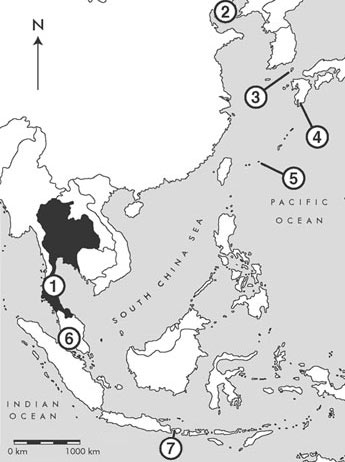
| METHODS Chumphon (10o28’N 99o13’E; sea level) is a town (population: 16,000) on the eastern coastal plain of southern Thailand, 460 km south-west of Bangkok, 550 km north of Malaysia, and 55 km east of Myanmar. The north-south Bilauktaung range of mountains 35 km to the west funnels many diurnal bird migrants through this 30-km wide coastal plain adjacent to the Gulf of Thailand (Wells 1999, Zalles and Bildstein 2000). Migration was observed at a site (10o28.40’N 99o13.26’E) in an unprotected freshwater marsh 4.6 km east-north-east of Chumphon, and approximately 2 km north-east of the coastal highway at Ban U-Tapao, Tha Yang subdistrict, Muang district, Chumphon province. The marsh is composed primarily of emergent aquatic plants, including sedges Carex spp., cat-tails Typha spp., and common reed Phragmites australis.Vegetation averages less than 1.5 m high, and it does not prevent observation of low-flying raptor migrants. On fair days, it is possible to see 10 km to the north-east, 3 km to the east and west, and about 1 km to the south. The weather in late summer–early autumn is determined by the interaction between a monsoonal low-pressure system in the Pacific Ocean to the east, and a high pressure system in the Andaman Sea to the west. In September and early October, the high pressure system prevails, and most winds are from the west or north-west. By mid-October, the low pressure system predominates, and winds are easterly. Heavy rain is common in mid-October as low pressure replaces high pressure in the region. The bulk of the migration occurs during the ‘south-west’ (April–October) rather than ‘north-east’ monsoon (November–January). We counted migrants from 27 September to 11 November, which correspond to the peak of the raptor movements in the area. Migrating raptors were counted by RDC using 10x binoculars, assisted at times by CN and DA. Count protocols followed those described in Bildstein and Zalles (1995). Most observations began at 07h00 local time and usually ended at 17h00. Most raptors (>95%) were readily identified to species using Porter et al. (1986), Clark (1999), Jeyarajasingham and Pearson (1999),Wells (1999) and Robson (2002). Weather conditions (wind speed, barometric pressure, temperature, humidity) were monitored hourly throughout the day with a hand-held Kestrel 4000 ‘weather station’ (Nielsen-Kellerman corporation, U.S.A.). Wind direction was determined with a compass. Observers scanned primarily north for approaching migrants. An individual was considered a migrant if it passed north-to-south across an imaginary east-west line at the watch site, and continued south out of sight. No attempt was made to determine the relative proportion of males versus females, or of adults versus immatures.Totals for large flocks (>300 individuals) of Black Baza Avecida leuphotes, Chinese Sparrowhawk Accipiter soloensis and Grey-faced Buzzard Bustatur indicus were estimated to the nearest 25 individuals. |
|||||||||||||||||||||||||||||||||||
| RESULTS Table 1 : Raptor species, numbers counted, and seasonal peaks at Chumphon, Thailand, in autumn 2003. |
|||||||||||||||||||||||||||||||||||
|
|||||||||||||||||||||||||||||||||||
| In
total, 170,665 raptors of 15 species were counted migrating during
378 hours of observation (averaging 452 birds/hour;Table 1). Black
Baza was the commonest migrant (68,219 individuals), representing
40% of the 163,020 individuals identified to species (Table 1). The
largest flock of this species, estimated at 1,300 birds, passed on
23 October. Chinese Sparrowhawk (57,667 individuals) made up 34% of
all individuals identified, with 550 individuals in one flock on 11
October. We also observed large numbers of Grey-faced Buzzard (14,962
individuals; 9%; largest flock = 500 individuals on 23 October) and
Oriental Honey- Buzzard Pernis ptilorhyncus (15,972 individuals;
9%; largest flock = 91 individuals on 7 October). The highest single day count was 56,101 individuals of ten species on 23 October (Fig. 2). A peak of 11 species was observed on 18 October.There were differences between species in their seasonal pattern of migration (Fig. 3). Of the five commonest species, Chinese Sparrowhawk and Oriental Honey-buzzard migrated through the area primarily before mid- October, Grey-faced Buzzard and Black Baza migrated primarily in late October, and Japanese Sparrowhawk Accipiter gularis migrated through the area throughout the autumn (Fig. 3). Raptors at Chumphon typically migrated throughout the day, sometimes from shortly after 07h00 until shortly before 18h00 (Fig. 4). On most days, movements of Chinese Sparrowhawk and Grey-faced Buzzard peaked at 09h00–10h00. Oriental Honey-buzzard migration peaked at 10h00–11h00. About half of all raptors (53%) were seen from 09h00 to12h00 (Fig. 4). On most days, counts decreased thereafter until 15h00–16h00, when they again increased. Most of the migrants (72%) were seen when cloud cover exceeded 70%. Between 12h00 and 15h30, raptors frequently flew at heights above 600–800 m, especially if winds were <8km/hour. Entire flocks of certain species (Chinese Sparrowhawk, Grey-faced Buzzard), and individuals of other species (Oriental Honeybuzzard, Japanese Sparrowhawk) sometimes disappeared into the bases of clouds when they soared in thermals. At 19h25 on 1 October 2003, CN observed a flock of about 50 Chinese Sparrowhawks entering a night-time roost in a coconut Cocos nucifera grove near the watch site. Several species, including Black Baza, Chinese Sparrowhawk, and Japanese Sparrowhawk roosted in coastal mangrove forests 10–15 km north of the site. We considered four species (Black Baza, Oriental Honey-buzzard, Chinese Sparrowhawk and Greyfaced Buzzard) to be obligate flocking migrants at the site (sensu Kerlinger 1989). We also observed mixedspecies flocks of Grey-faced Buzzard and Black Baza, and of Japanese and Chinese Sparrowhawk. Individuals of several other species (e.g. Osprey Pandion haliaetus, Black Kite Milvus migrans and Greater Spotted Eagle Aquila clanga) were sometimes seen in groups of two or more individuals. Several researchers (Ash 1993, Wells 1999, Nijman 2001b, Robson 2002) have noted flocks of Japanese Sparrowhawk in South-East Asia, but we did not see single-species flocks of this species at Chumphon. More raptors were counted at the site on winds from the west or north-north-west than the east or south (P² = 41.7, P<0.05). From 27 September to 25 October, winds were typically light to moderate for the entire day. Later in the season, early morning westerly or variable winds shifted to on-shore, easterly winds by about 10h00. Raptors were then seen primarily flying north-to-south-west of the site, and after noon few raptors were observed passing over the site itself. Three additional raptor species (Black-shouldered Kite Elanus caeruleus, Brahminy Kite Haliastur indus, and White-bellied Sea Eagle Haliaeetus leucogaster) were resident in and around Chumphon and were not counted. Non-raptors seen migrating, or apparently migrating, at the watch site included Little Cormorant Phalacrocorax niger, Grey Heron Ardea cinerea, Purple Heron Ardea purpurea, Oriental Pratincole Glareola maldivarum, Grey-headed Lapwing Vanellus cinereus, Pale-capped Pigeon Columba punicea, House Swift Apus affinis, Asian Palm Swift Cypsiurus balasiensis, Fork-tailed Swift Apus pacificus, Blue-throated Beeeater Merops viridis, Blue-tailed Bee-eater Merops philippinus, Barn Swallow Hirundo rustica, Red-rumped Swallow Hirundo daurica, Sand Martin Riparia riparia, Ashy Minivet Pericrocotus divaricatus and Black Drongo Dicrurus macrocercus (see DeCandido et al. 2004). |
|||||||||||||||||||||||||||||||||||
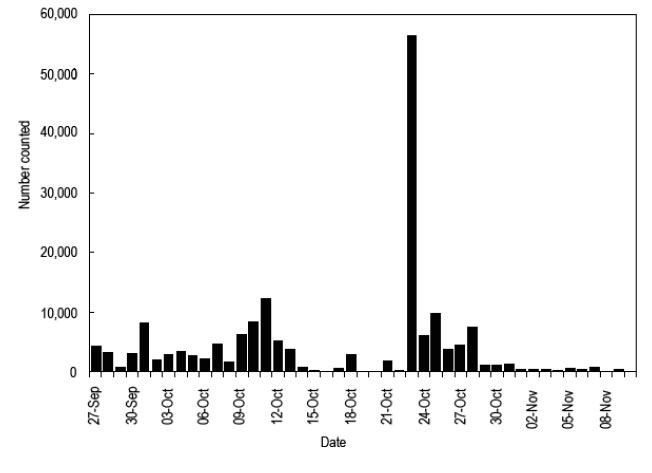 Figure 2 : Daily totals of raptors counted on migration at Chumphon,Thailand, autumn 2003. 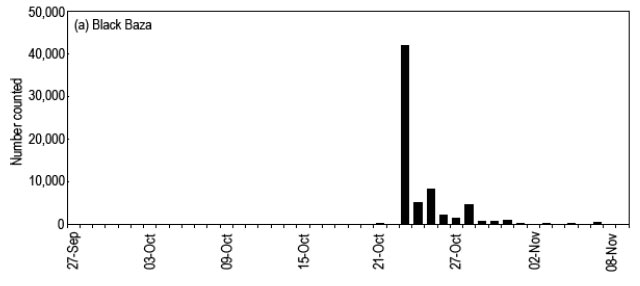 Figure 3(a) : Number of Black Baza counted at Chumphon,Thailand, in autumn 2003. 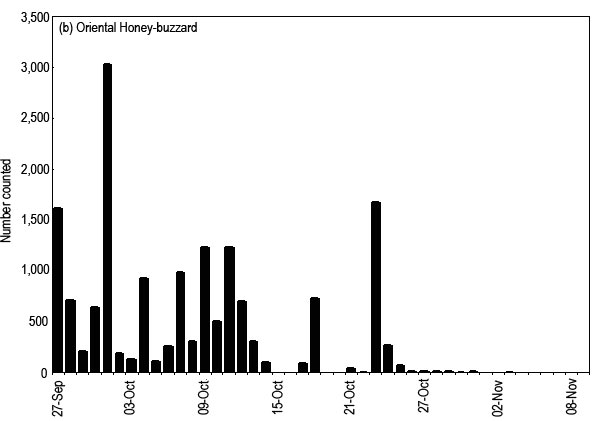 Figure 3(b) : Number of Oriental Honeybuzzard counted at Chumphon,Thailand, in autumn 2003. 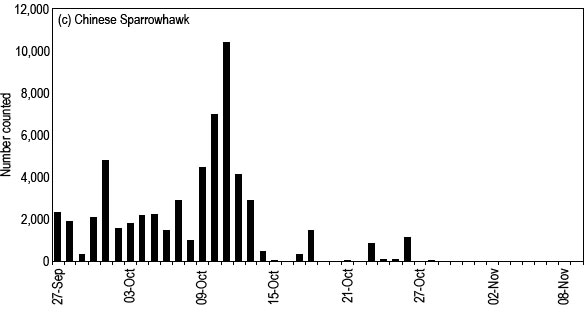 Figure 3(c) : Number of Chinese Sparrowhawk, counted at Chumphon,Thailand, in autumn 2003. 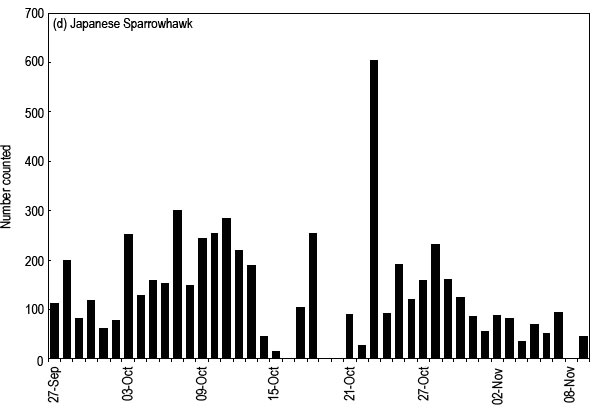 Figure 3(d) : Number of Japanese Sparrowhawk, counted at Chumphon,Thailand, in autumn 2003. 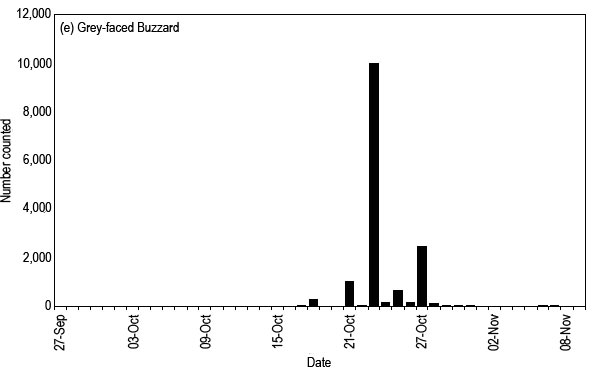 Figure 3(e) : Number of Grey-faced Buzzard, counted at Chumphon,Thailand, in autumn 2003. 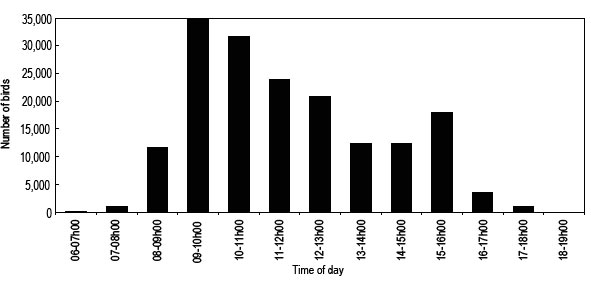 Figure 4 : Pattern of raptor migration through the day (birds/hour) at Chumphon, Thailand, in autumn 2003. |
|||||||||||||||||||||||||||||||||||
| DISCUSSION Our counts demonstrate a significant autumn movement of soaring raptors at Chumphon, Thailand. The number of raptor species observed (15), the number of individuals counted (170,665), and the average number of raptors counted per hour (452) are the highest totals reported to date in South-East Asia. The numbers of five species (Black Baza, Oriental Honey-buzzard, Eastern Marsh Harrier, Chinese Sparrowhawk, and Grey-faced Buzzard) appear to be among the highest single-season totals reported in Asia (Medway and Nisbet 1964, Lin and Lin 1986, Severinghaus 1991, Ash 1993, Kugai 1996, Chong 2000, Nitani 2000, Williams 2000, Nijman 2001b, Tordoff 2002; see Table 2). Based on our observations, we estimate that as many as 500,000 raptors may migrate south over Chumphon each year between August and early December. This makes Chumphon a watch site of global significance (Yosef et al. 2000, Zalles and Bildstein 2000). |
|||||||||||||||||||||||||||||||||||
|
|||||||||||||||||||||||||||||||||||
| *Unpublished
data indicate that a higher count was made at the Miyako islands (Ryukyus),
Okinawa, Japan: 53,575 individuals in autumn 1980; data from 1973–2003
give an annual mean of 27,859 individuals (Y. Nitani in litt. 2004). Small numbers of two other raptors (nine Steppe Eagles Aquila nipalensis and two Imperial Eagles Aquila heliaca) were seen migrating in early November at a location c.8 km west of the site (not included in Table 1). Further research may determine if several other raptor species that are regarded as migrants in Thailand (Hen Harrier Circus cyaneus,Western Marsh Harrier C. aeruginosus aeruginosus, Shikra Accipiter badius and Eurasian Sparrowhawk A. nisus) also regularly pass through the area. The raptors counted at Chumphon are thought to follow at least two migration routes in East Asia: (a) an Eastern Inland Corridor that extends from southeastern Siberia through eastern China and Indochina (Laos, northern Vietnam, northern Thailand), south through the Thai-Malay Peninsula; and (b) a Coastal Pacific Corridor that extends from north-eastern Siberia, Amurland, and Ussuriland through coastal China, south into Indochina and the Thai-Malay Peninsula (McClure 1998, Zalles and Bildstein 2000). Movements along these corridors are poorly understood, and additional study is needed to determine the routes used by different raptors in the Far East (Ellis et al. 1990, Lane and Parish 1991, Severinghaus 1991, Ash 1993, Chong 2000, Nitani 2000, Williams 2000, Nijman 2001a,Tordoff 2002). Satellite-tracking of two Oriental Honey-buzzards in autumn 2003 showed that they left their breeding grounds in Japan in mid-September, crossed to mainland China and headed south-west across Indochina, then south through the Thai-Malay Peninsula to Sumatra (H. Higuchi in litt. 2004). Further studies may reveal the extent to which outbound raptors including Oriental Honey-buzzard, Chinese Sparrowhawk and Grey-faced Buzzard, follow the Oceanic Pacific Corridor, before heading west to the mainland, and south into Malaysia and Indonesia. Weather conditions had a major influence on the number of raptors migrating. Significantly more raptors were seen when winds were from the northwest quadrant than when winds were from the south-east quadrant. Raptors seemed to ‘drift’ to the coast with westerly winds when skies were overcast and when strong thermals were lacking. With moderate westerly winds, as many as 10% of the migrants passed approximately 2 km to the east of the site along the Gulf of Thailand. On 23 October, we counted 56,101 migrants during overcast skies and light to moderate west to north-west winds. On that day the area <7 km north and west of the watch site was free of precipitation, but it was raining throughout much of central and northern Thailand. Although steady rain at the watch site ended raptor migration there, we believe that local rains simply diverted migrants around the precipitation cell. Observers in the Neotropics have also noted migration in light or intermittent rain and overcast skies (Bildstein and Saborio 2000). |
|||||||||||||||||||||||||||||||||||
| RECOMMENDATIONS The raptor migration at Chumphon affords an exceptional opportunity for research and education. We recommend a season-long autumn count by experienced observers from mid-August to late November, as well as exploratory partial season spring counts in mid- March through mid-May. Several (3–4) observers would be needed in order to reduce observer fatigue. Training of local people to assist with counts is needed. Consideration should be given to a coordinated transect count in the region, including searching for large overnight roosts. There is no comprehensive guide to flight identification of raptors for this part of the world, and we suggest that printed and on-line guides to the different raptors of East Asia be developed as quickly as possible. A poster depicting raptor diversity in Thailand and South-East Asia could serve as a keystone visual aid providing information about Asian raptors. A children’s colouring book of the common birds of Thailand with basic information about urban and suburban raptors would create interest at the grassroots level. |
|||||||||||||||||||||||||||||||||||
| ACKNOWLEDGEMENTS We sincerely appreciate the encouragement and thoughtful advice of Phil Round of Mahidol University. Uthai Treesucon of Bangkok provided many helpful ideas and suggestions to the raptor watch team. We thank Hiroyoshi Higuchi of the University of Tokyo for sharing some unpublished information. Yasunori Nitani of the Asia Raptor Research and Conservation Organization (ARRCN) provided migration count data for Chinese Sparrowhawks and Greyfaced Buzzards in Japan. Anne Arrowsmith designed the map. We deeply appreciate the kindness shown to us by our colleagues of the Malaysian Nature Society including Laurence and Audrey Poh, Cheang Kum Seng, Liew Siew Lan and Ooi Beng Yean, Regina Anthony and Chiu Sein Chong as well as Lim Aun Tiah and Lim Kim Chye. Desmond Allen provided GPS coordinates of the site. David Wells read a version of this manuscript and provided helpful comments. Those wishing to observe raptor migration at Chumphon should contact Chukiat Nualsri (bntern@chaiyo.com) for details about how to reach the watch site, and the annual Raptor Watch festival usually held in the second week of October. Our research was supported by grants from the Bobolink Foundation and the Oriental Bird Club, and by a Hawk Mountain Sanctuary Project Soar Award. This is Hawk Mountain Sanctuary Contribution to Conservation Science number 108. |
|||||||||||||||||||||||||||||||||||
| REFERENCES Ash, J. S. (1993) Raptor migration on Bali, Indonesia. Forktail 9: 3–11. Bildstein K. L. and Zalles, J. I., eds. (1995) Raptor migration watchsite manual. Kempton, U.S.A.: Hawk Mountain Sanctuary. Bijlsma, R. (1996) Raptor migration in Thailand in November 1984. Nat. Hist. Bull. Siam Soc. 44: 147–150. Bildstein, K. L. and Saborio, M. (2000) Spring migration counts of raptors and new world vultures in Costa Rica. Ornitologia Neotropical 11: 197–205. Chong, M. (2000) Asian raptor migration areas and population survey (Asian Raptor M.A.P.S.): cooperative raptor migration in haze project: autumn 1999 report summary. Bull. Asian Raptor Res. Cons. Network 1: 12–15. Clark, W. S. (1999) A field guide to the raptors of Europe, the Middle East and North Africa. New York: Oxford University Press. DeCandido, R, Nualsri, C. N., and Allen, D. (2004). Migration of Black Drongo Dicrurus macrocercus in southern Thailand, in autumn 2003. Forktail 20: 143–144. Ellis, D. H., Kepler, A. K, and Kepler, C. B. (1990) Evidence for a fall raptor migration pathway across the South China Sea. J. Raptor Res. 24: 12–18. Jeyarajasingham, A. and Pearson, A. (1999) A field guide to the birds of West Malaysia and Singapore. New York: Oxford University Press. Kerlinger, P. (1989) Flight strategies of migrating hawks. Chicago: University of Chicago Press. Kugai, K. (1996). Autumn migration of Butastur indicus Grey-faced Buzzard-eagle in Japan. Bull. Okinawa Prefectual Mus. 1996: 154–172. Lane, B. A. and Parrish, D. (1991) A review of the Asian-Australian bird migration system. Pp. 291–312 in T. Salathé, ed. Conserving migratory birds. Cambridge, U.K.: International Council for Bird Preservation (Techn. Publ. 7). Lekagul, B., Round, P. D., and Komolphalin, K. (1985). Birdwatching for Palearctic migrants in Thailand. Brit. Birds 78: 2–39. Lin, S. S. and Lin, M. H. (1986) A survey of Gray-faced Buzzard- Eagle hunting in ManChou area. Taiwan: KenTing National Park (Conservation Research Republication 10). McClure, H. E. (1998) Migration and survival of the birds of Asia. Bangkok: White Lotus Press. Medway, L. and Nisbet, I. C. T. (1965) Bird report: 1964. Malay. Nat. J. 19: 160–194. Melville, D. S. and Fletcher, W. E. (1982) Diurnal observations of bird migration in Central and Western Thailand. Nat. Hist. Bull. Siam Soc. 30: 49–50. Nijman, V. (2001a) Autumn migration of raptors on Java, Indonesia: composition, direction and behaviour. Ibis 143: 99–106. Nijman, V. (2001b) Spatial and temporal variation in migrant raptors on Java, Indonesia. Emu 101: 259–263. Nitani, Y. (2000) Result of the cooperative study of Asian raptor migration in hazy conditions in Japan. Pp. 83–91 in D. M. Prawiradilaga, ed. Proceedings and abstracts on the second symposium on raptor research and conservation of Asia. Jakarta: Indonesian Committee for the Second Symposium of Asian Raptor Research and Conservation. Porter, R. F., Willis, L., Christensen, S. and Nielsen, B. P. (1986) Flight identification guide of European raptors. 3rd ed. Calton, U.K.: T. and A. D. Poyser. Robson, C. (2002) Birds of Thailand. U.K.: New Holland. Severinghaus, L. L. (1991) The status and conservation of Greyfaced Buzzard-eagles and Brown Shrikes migrating through Taiwan. Pp. 203–223 in T. Salathé, ed. Conserving migratory birds. Cambridge, U.K.: International Council for Bird Preservation (Techn. Publ. 7). Tordoff, A. W. (2002) Raptor migration at Hoang Lien Nature Reserve, northern Vietnam. Forktail 18: 45–48. Wells, D. R. (1990) Malayan bird report: 1982 and 1983. Malay. Nat. J. 43: 116–147. Wells, D. R. (1999) The birds of the Thai-Malay Peninsula. London, U.K.: Academic Press. Williams, M. D., ed. (2000) Autumn bird migration at Beidaihe, China, 1986–1990. Hong Kong: Beidaihe International Birdwatching Society. Yosef, R., Fornasari, L. and Giordano, A. (2000) Soaring migrants and the 1% principle. Ring 22: 79–84. Zalles, J. I. and Bildstein, K. L. (2000) Raptor watch: a global directory of raptor migration sites. Cambridge, U.K. and Kempton, U.S.A.: BirdLife International and Hawk Mountain Sanctuary. |
|||||||||||||||||||||||||||||||||||
| Kindly
submitted by: Robert DeCandido, Acopian Center for Conservation Learning,Hawk Mountain Sanctuary, 410 Summer Valley Road, Orwigsburg, Pennsylvania 17961 U.S.A. Correspondence: 1831 Fowler Avenue,The Bronx, New York 10462-3708. Email: rdcny@earthlink.net Chukiat Nualsri,Thayang Administrative Organization, 135-1 Kromluang Chumphon Road, Muang Chumphon 86000,Thailand. Email: bntern@chaiyo.com Deborah Allen,The Linnaean Society of New York, P.O. Box 1452 Peter Stuyvesant Station, New York 10009, U.S.A. Email: dallenyc@earthlink.net Keith L. Bildstein, Acopian Center for Conservation Learning,Hawk Mountain Sanctuary, 410 Summer Valley Road, Orwigsburg, Pennsylvania 17961 U.S.A. Email: bildstein@hawkmtn.org |
|||||||||||||||||||||||||||||||||||
| Tweet | |||||||||||||||||||||||||||||||||||

A Guide to Birdwatching in Thailand. Copyright © 2004-2017 thaibirding.com. All rights reserved.