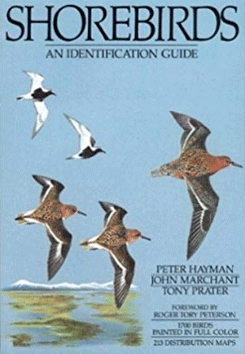
Authors: Peter Hayman, John Marchant & Tony Prater
Since its publication in 1991 this has been the premier reference
book for shorebirds around the world.
Eighty-eight detailed and well-annotated plates show all of
the world's 214 wader species with distribution maps and identification
notes on the opposite page from the plates. Additionally,
the second half of the book provides detailed notes on identification,
call, habits, migration etc. The two sections of the book
are nicely linked by referring the reader to the right page
for the text for each illustrated species, meaning that it
can be quickly found, rather than leaving the user to flick
through pages of text while trying not to lose the page containing
the picture. The book also contains a bibliography, which
is referenced throughout the book, for those wishing to read
more on any individual species and the index refers to plates
and text, and is concise, easy-to-use and contains both scientific
and common names together.
The size of this book is a little large for a field identification
guide but considering the large amount of information
contained within it the size remains manageable, although
a large pocket would be needed to carry it while birding.
Considering the scope of this book, covering shorebirds from
all continents, this is probably best regarded as a reference
book, rather than a field guide, although I have taken it
out with me when visiting sites with large shorebird concentrations.
The illustrations are mostly excellent, although in some cases
the plates are a little crammed and at times it can be tricky
to see immediately which is which; this small problem is largely
a result of the attempt that has been made to keep the book
as small as possible.
This book is invaluable to birdwatchers who have an interest
in the identification of difficult shorebirds, particularly
if having any aspirations of becoming adept in finding vagrant
species among those that are more familiar. The global distribution
maps are particularly interesting, although perhaps a little
dated and innacurate now, giving those that study them an
insight into what rarities may turn up in various places around
the world. The fact that most subspecies are illustrated,
and all listed, is excellent, giving birders and in-depth
insight into the difficulties of identifying some species
and the care that must be taken; the details of the subspecies
of Greater and Lesser Sand Plovers are a good example of this.
While this remains the best worldwide shorebird reference
book available it would benefit from some updates, particularly
regarding the conservation status of many species and some
taxonomic advances such as White-faced Plover and the knowledge
that Cox's Sandpiper is a hybrid. These small issues aside
I would still highly recommend this book to birders, in fact
if you only buy one book dealing with specific groups of birds,
make it this one. There are a number of second-hand copies
available on Amazon for a very good price - Shorebirds:
An Identification Guide
Score: 9/10
Other Relevant Books
Waders
of Europe, Asia & North America - Published
in 2005 this field guide is small enough to genuinely be
used as a field guide for those interested in waders in
the northern hemisphere. Great illustrations, range maps
and concise texts but lacking the expansive information
of the above publication.
Waders
of Britain & Europe with North Africa & the Middle
East - A handy little field guide specializing in
the waders of this region. Small enough to go in the pocket
and pleasant to browse through at home this publication
will increase a birder's knowledge of identifying waders
but does not contain much information about each species.



 Waders
of Europe, Asia & North America
Waders
of Europe, Asia & North America Waders
of Britain & Europe with North Africa & the Middle
East
Waders
of Britain & Europe with North Africa & the Middle
East

 Download
a full
Download
a full