Doi Inthanon National Park, at 482
square kilometres, protects four major watersheds and, of
course, Thailand's highest mountain, Doi Inthanon, which has
its summit 2565 metres (8415 feet) above sea level. This National
Park, in Chiang Mai province, is unique in Thailand as it
is 300 metres higher than any other mountain in the country
which allows it to support a tract of upper montane forest
and Thailand's only sphagnum bog (albeit a very small one).
Although there is quite extensive deforestation in places,
due to a sizeable hill-tribe population, there remain large
areas of quality habitat which is home to a very high number
of species. The long road to the summit provides many places
to stop and access the forest which is magnificent in places;
particularly the moss-clad forest at higher altitudes.
There are a number of accommodation options inside and outside
the park allowing bird watchers to spend lots of time on the
trails to look for the many ornithological treats that await.
Birds seem to be in greater densities here than in many other
locations in Thailand, meaning that this is an ideal place
to see a large number of species in a short space of time
and one of the most memorable locations for bird watching
in Thailand.
From mid November to early February it can get quite cold
at the higher altitudes of the mountain and this cool weather
attracts large numbers of Thai tourists from the hot lowlands
who come to see the small patches of frost that sometimes
form and to experience being cold. It is good to avoid weekends
and holidays during this period.
Doi Inthanon has so many birding highlights it is almost
impossible to mention them all without giving the entire checklist
for the National Park. This mountain spans a number of habitats
and consequently contains the birds associated with them.
The summit area, which is higher than any other in Thailand,
provides some of the most memorable bird watching on the mountain,
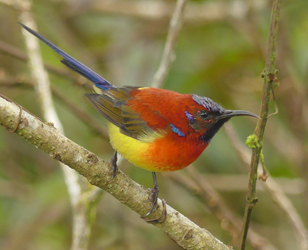
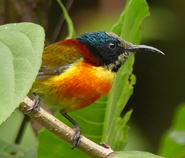
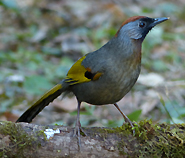
perhaps even the whole country; Chestnut-tailed Minla, Green-tailed
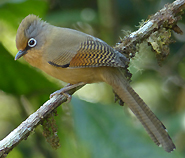
(Inthanon) Sunbird, Rufous-winged Fulvetta and Silver-eared
Laughingthrush are very abundant in this area and both Speckled
and Ashy Woodpigeon are frequently seen while the summit boardwalk
gives birders an opportunity to see skulking species such
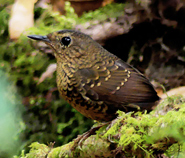
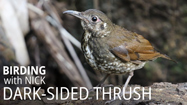
as Himalayan Shortwing, Pygmy Cupwing and Dark-sided Thrush.
A little further down the mountain Green Cochoa is a highly
sought-after species which takes a lot of luck to see and
being present in the right season (March to July), and flocks
contain colourful birds such as Clicking Shrike-babbler, Yellow-cheeked
Tit, Golden Babbler and Rufous-backed Sibia. Brown-throated
Treecreepers are easily found as are many other high altitude
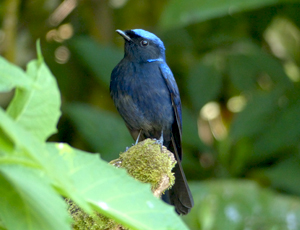
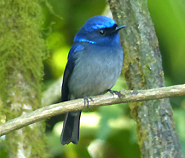
specialities including Small and Large Niltavas.
In the rivers near the waterfalls Slaty-backed Forktail and
Plumbeous Water Redstart can be seen foraging amongst the
rocks and White-capped Water Redstart (River Chat) is a must
see bird which no illustration does justice to; to me this
is one of the most beautiful birds to be found in Thailand.
Doi Inthanon used to be one of the few places in the world
where birders had a realistic chance of seeing the secretive
Black-tailed Crake, but in recent years sightings have been
few due to changes to the target area; the birds are still
there, just a lot harder to see now.
The drier forest, on the lower slopes of the mountain, contains
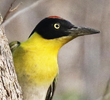
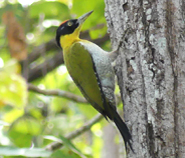
some species that specialize in this habitat; Black-headed
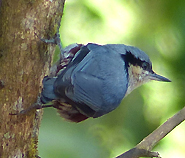
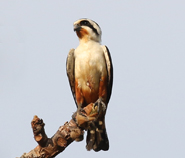
Woodpecker, Burmese Nuthatch and White-rumped Falcon are the
most sought after birds here and Black-backed Forktail is
present in the streams. Birding does tend to be extremely
slow in this area though and things can get very hot for long
periods at this lower altitude.
The sheer size of Doi Inthanon National Park means that a
high species total can be accumulated on any visit, and by
staying for three or four days and birding at a wide range
of altitudes a large number of exciting birds can be seen
which will match the variety of habitats.
Use the interactive map below to plan your route to
Doi Inthanon. The blue line shows the route from Chiang Mai
(Blue Pin) to the park gate (Green Pin) and on to the summit
of the mountain (Red Pin).
By Car/Motorcycle
Getting to Doi Inthanon is easy if driving your own vehicle
and getting to HQ will take about 1.5 hours from downtown
Chiang Mai. From Chiang Mai city get on the road which heads
out to the airport and continue all the way to Chom Thong
from which Doi Inthanon is clearly sign posted. Although it
is easy to get to Doi Inthanon without private transport it
is highly advisable to hire a car to fully enjoy the park;
the birding hotspots are a long distance apart and without
transport lots of walking, hitch-hiking or flagging down irregular
songtaews will be required. The road up Doi Inthanon is well-maintained
and a four-wheel drive vehicle is not needed, although automatics
cope with the steepest parts of the mountain very badly. Driving
to the summit from Chom Thong takes around 45 minutes and
vehicles can be hired in Chiang Mai for as little as 1000
baht a day with just a passport as deposit.
By Songtaew/Bus
There are no vehicles that most foreigners would recognize
as buses but there are regular songtaews from Chiang Mai to
Chom Thong (pronounced Jorm Torng). Songtaews are either red
or yellow pick up trucks with covered seating in the back
and are obviously a form of public transport even to the unfamiliar.
The songtaews for Doi Inthanon depart from the south side
of the moat, opposite Chiang Mai gate (zoom in to the map
above to see where blue pin "A" is positioned).
These vehicles regularly go to Chom Thong where you will need
to get another songtaew. These days there are lots of people
going up the mountain and you should not have to wait long
for a songtaew to be full and head up the mountain. However,
if you arrive on a quiet day then you may have to wait a long
time or even need to charter a vehicle to get you to where
you want to go. Somewhere around 500-700 baht should be about
the right price for a private hire of a songtaew.
By Taxi
There are few metred taxis in Chiang Mai but most hotels will
be able to arrange a taxi to Doi Inthanon if required. The
other easy location to arrange a taxi is from Chiang Mai airport.
It is also possible to flag down a songtaew in Chiang Mai
and charter it to be used as a private taxi.
By Tuk Tuk or Motorcycle Taxi
Although both these styles of transport are abundant in Chiang
Mai it is far too far to Doi Inthanon for these to be a viable
means of accessing the mountain. Not to be advised.
By Train
Chiang Mai city can be reached by train from Bangkok, many
people like to make an overnight journey, the timetable can
be seen here: Train
Travel from Bangkok to Chiang Mai. From here you can either
use the instructions above to get to Doi Inthanon by public
transport or private vehicle.
By Plane
There are a large number of flights arriving at Chiang Mai
airport from cities all over Thailand as well as from many
international destinations around Southeast and East Asia.
Once at the airport then either hire a car, taxi or use public
transport to get to Doi Inthanon. If you have booked one of
the hotels just outside Doi Inthanon national park it may
be possible to arrange for them to collect you at the airport.
Bird
Watching Trips:
If you need help organizing a bird watching trip to Thailand,
take a look at the suggested itineraries for ideas on
creating a tailor-made trip and contact me for advice:
Thailand
bird tours.
Finding Birds
There are a large number of locations at which one can
stop and observe birds on Doi Inthanon, and if so inclined
there is the opportunity to find new and "unexplored"
trails. However, here are some of the established birding
locations.
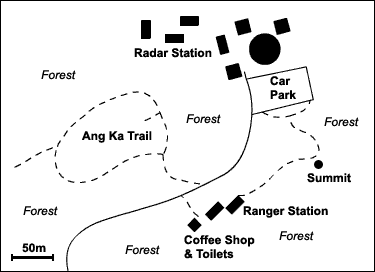
Summit area :
As soon as one arrives at the summit car park the birding
starts in this area; good numbers of leaf warblers, particularly
Ashy-throated Warbler, are always present in the vegetation
around here and Silver-eared Laughingthrush, Chestnut-tailed
Minla, Rufous-winged Fulvetta and Green-tailed Sunbirds are
always around to add a splash of colour, Dark-backed Sibia
and Flavescent Bulbul are usually very obvious too, sometimes
feeding on scraps left by tourists. All these species resident
species are easily seen in both the wet and dry seasons.
The "Ang Ka" boardwalk trail is wonderful and takes
visitors through forest that is like a scene from Lord of
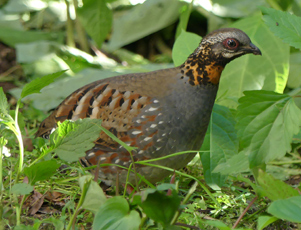
the Rings; Himalayan Shortwing, Pygmy Cupwing and Rufous-throated
Partridge are ever present but not always easily seen; listen
for their calls and you may find them. Lots of other great
resident birds often occur in this area including Snowy-browed
Flycatcher, Ashy Woodpigeon, Davison's Leaf Warbler, Blyth's
Leaf Warbler, Yellow-bellied Flowerpecker, Yellow-browed Tit
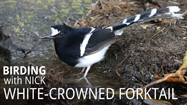
and White-crowned Forktail so it is worth spending a whole
morning on this short trail enjoying these colourful birds.
In the "winter" months (and it can be really cold
here for much of the morning in December and January) the
summit region is a good place for migrant species and is a
particularly good place to find and study leaf warblers as
many of them can be seen in low trees, making it easier to
observe these hard-to-identify birds. Ashy-throated, Davison's
and Blyth's are resident but Buff-barred and Yellow-browed
are also common as migrants. It can be very busy with people
in these coldest periods, particularly at weekends, but the
majority of the birds seem quite accustomed to the crowds,
although some of the shyer birds will be harder to find.
A number of other migratory species also regularly occur in
this area with Dark-sided Thrush being a speciality, foraging
on the forest floor, and in some years Eurasian Woodcock can
be found too. While they are never common, it is worth looking
for migratory thrushes between the months of December and
April with Eyebrowed Thrush being the most regular but Grey-sided
is also recorded annually with Chestnut Thrush seen every
other year or so.
Near the coffee shop is a surprisingly good place to observe
some of the commoner species close-up as the birds to feed
on scraps of food left by touristsas well as flowering and
fruiting trees in the garden; Chestnut-tailed Minla, Dark-backed
Sibia and Silver-eared Laughingthrush are extremely tame here
and Rufous-throated Partridge often comes out to feed on scraps
both here and behind the ranger station; although the rangers
don't seem to want birders hanging out in that area any more.
Ashy Woodpigeon is often seen at the summit resting in trees
behind the toilet block but when there is most disturbance
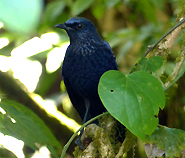
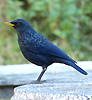
they frequently desert the area although a Blue Whistlingthrush
in the same spot is usually more tolerant of humans.
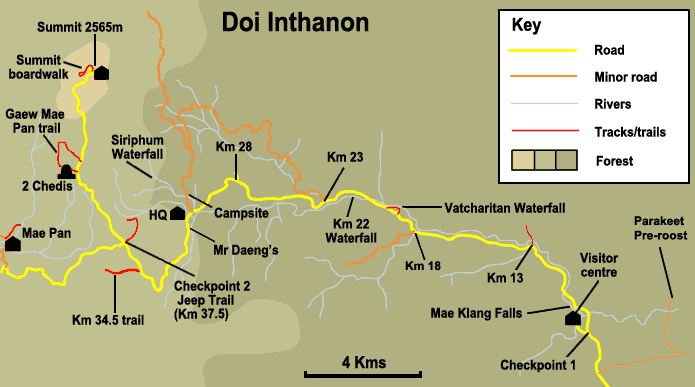
Gaew Mae Pan
trail : I have only ever walked a short section
of this trail on just one occasion, but it appears to have
potential as it winds through some moist and interesting forest.
This trail is high enough up the mountain for most of the
summit specialities to be present and I saw a number of flycatchers
along here, with Vivid Niltava being the most notable. However,
it seems that one must hire a ranger to go along this trail;
I do not know why but having paid the entry fee of 300
baht to get into the park it seems a bit of an
imposition to have to pay again to walk a trail. However,
there is a great viewpoint from the car park from this trail
and there are regular sightings of Himalayan Goral from the
trail itself, so anyone who wants to catch up with this rare
mammal should speak to the park staff here.
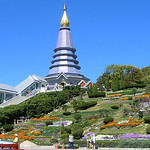
2 Chedis
: These two modern chedis are in an open area which can
provide some great views over the surrounding countryside
on a clear day. Green-tailed Sunbird is common here, feeding
on nectar in the ornamental gardens and often one can get
very close to this species here. Buff-throated Warbler often
puts in an appearance in the scrubby areas behind the left-hand
chedi as one enters the area, and is one of the more attractive
Phylloscopus warblers in Thailand in my opinion.
A damp patch of forest behind the toilets here seems very
productive for flycatchers, particularly Niltavas and I've
also seen Snowy-browed and White-gorgetted Flycatchers here.
Hanging around the toilets with a pair of binoculars can draw
a few stares however. A fee of 40 baht must be paid to enter
this area which I'd like to think goes towards the upkeep
of the chedis but is much more likely to fill the pockets
of high ranking park officials.
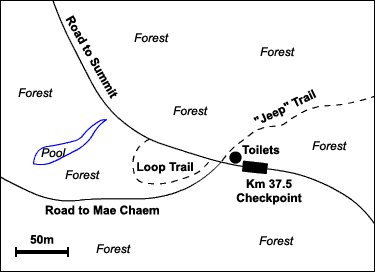
Checkpoint 2/Jeep
Trail (Km 37.5) : This has been one of the
most popular birding areas on Doi Inthanon so don't be surprised
to meet other birders here although these days the amount
of traffic passing through often makes birding here very difficult
and even dangerous, so be careful. However, on quieter days
birding along the road can be very rewarding with flocks of
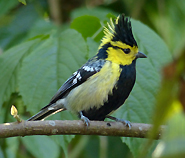
birds including Grey-throated Babbler, Clicking Shrike-babbler
and the beautiful Yellow-cheeked Tit. Spectacled Barwing and
Silver-eared Mesia are both fairly reliable here too and are
wonderful birds. Other species often seen from the road include
Asian Emerald Cuckoo, Small Niltava, Himalayan Black Bulbul,
Short-billed Minivet and Eyebrowed Thrush.
The jeep track itself is easily missed as its entrance is
quite overgrown: it is on the right immediately after the
toilet block, just after the checkpoint - it is many years
since anyone could get a jeep down here and it is more of
a narrow forest trail these days which had overthrown trees
across it at regular intervals making it more like an obstable
course at points. However, it goes on for several kilometres
giving deep access to the forest.
The excellent forest here is regarded as a good site for Green
and Purple Cochoas, although one should not be fooled into
thinking that these are easy species to see though, particularly
with many Purple Cochoa sightings from here being very unreliable
considering the total lack of photographic evidence and almost
no resident Thai birders having ever seen one down here!!!!
Green Cochoa is best looked for from March to July and Purple
Cochoa isn't often seen outside of April; Green Cochoa is
very scarce and shy, Purple Cochoa is mythical.
This trail is very good for looking for skulking species,
all of which are much easier to see in the wet season than
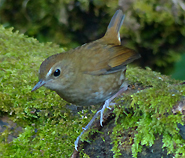
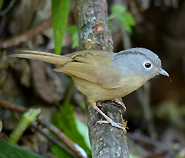
in the dry. Slaty-bellied Tesia is unusually common along
here and sightings of Eyebrowed Wren Babbler, White-tailed
Robin, Pygmy Cupwing and Lesser Shortwing are regular, but
getting a good view of them can be challenging.
Flocks of birds seem to always be a feature of this trail
and the noisy Grey-cheeked Fulvetta often gives their presence
away. This species is usually joined by Rufous-winged Fulvetta,
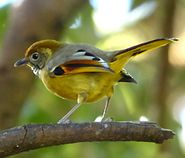
Golden Babbler, Davison's Leaf Warbler and Grey-headed Canary
Flycatcher but other birds such as White-bellied Erpornis,
Clicking Shrike-babbler, Yellow-browed Tit, Hume's Treecreeper
and Chestnut-crowned Warbler often join these bird waves too.
Other birds which can be found along here include Red-headed
Trogon, Green Magpie, White-necked Laughingthrush and, for
a lucky few, Rusty-naped Pitta.There are so many good birds
to find on this trail that one could spend the whole day on
it when bird activity is high, although sometimes there can
be frustratingly few birds. However, this trail goes though
some of the most mature forest on Doi Inthanon and even on
quiet days views of Hume's Treecreeper, Small Niltava, Slaty-bellied
Tesia and Large Niltava (listen for its "Doh, Ray, Me"
call) should be possible.
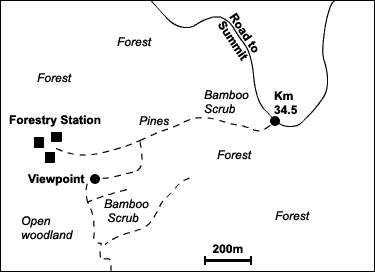
Km 34.5 Trail
: This trail consists of a jeep track which splits into
two branches after about 1 kilometre; one stopping at a forestry
research station and the other meandering for miles through
open scrubland and forest. There is enough space at the entrance
to the trail to park three or four cars but try not to block
the space that can be used to turn around or you may block
somebody in. The track passes through bamboo scrub and some
nice forest in the first kilometre and although the first
part is quite steep, don't worry, it soon flattens out. be
careful though, when it is wet the track can be quite slippery
and if you fall over you will not be the first!
The open habitat in the first few hundred metres can be a
good location to see some really nice birds, particularly
the extremely colourful Silver-eared Mesia which is one of
the most beautiful birds around. If this one does not impress
you then I suggest that you need to take up another hobby.
Flocks of birds here can often contain Clicking Shrike-babbler
and Rufous-backed Sibia, two more very striking birds, while
the commoner Grey-cheeked Fulvetta will be in every flock
that passes. Grey-chinned Minivet is another colourful species
that joins flocks higher in the trees along with Davison's
Leaf Warbler, White-browed Shrike-babbler and Chestnut-vented
Nuthatch; for the lucky few Black-throated Parrotbill may
put in an appearance.
Several species of high altitude Bulbul can frequently be
seen here in a morning with Mountain Bulbul being common along
with Flavescent and Striated Bulbul which often gives itself
away with its "hiccup" call.
As the trail flattens out some nice forest is on either side
and a wide variety of species is always possible; Golden-throated
Barbet and Maroon Oriole are often calling here but can be
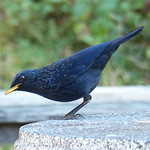
tricky to see in the canopy. Blue Whistlingthrush will often
be encountered on the track itself, in the dry season the
migratory caeruleus subspecies joins the resident
yellow-billed eugenei subspecies and is easily mistaken
for rarer birds!!! Look out for White-necked Laughingthrush
and Long-tailed Broadbill in the breeding season.
An area of pine trees often holds Hume's Leaf Warbler and
in late March its buzzing song can sometimes be heard before
it departs for its breeding ground. The pines are a great
place to see parasitic orchids at the right time of year.
Some open patches in the understorey of the forest on this
trail are good places to look for skulking birds such as Slaty-bellied
Tesia, Pygmy Cupwing and White-gorgetted Flycatcher. For those
who like a challenge both Bianchi's and Marten's Warblers
occur here, the only reliable way of identifying them is by
call due to worn plumages confusing any slight differences
there may be. To add to the confusion a third species, Grey-crowned
Warbler, is also found here although it seems to prefer the
more open areas with a grassy understorey.
Further along the trail emerges into some open country where
there is a great viewpoint out over the mountain. This habitat
contains some different species for some variety to a morning's
birding with Red-whiskered Bulbul, Fire-breasted Flowerpecker
and Rusty-cheeked Scimitar-babbler all being common. It is
also a good place to look out for soaring raptors such as
Oriental Honey-buzzard and Grey-faced Buzzard. Skulking species
such as Hill Prinia and Russet Bush Warbler also exist here
but seeing them in the thick vegetation is a real challenge.
This trail goes on for many kilometres for those who like
hiking and it could turn up some unusual birds.
Mr Daeng's
: Mr Daeng has a beautiful collection of bird
photographs and a restaurant in a convenient location. Birds
such as Little Spiderhunter, Grey-breasted Prinia, Black-throated
Sunbird, Banded Bay Cuckoo and Olive-backed Sunbird can be
found in the garden and it is always worth checking out the
trees at the entrance to Mr Daeng's which have mistletoe on
them which is frequently visited by Plain Flowerpecker and
various species of White-eye. A stakeout used to be maintained
here in the past, with some good birds, but for some reason
Mr Daeng doesn't bother with this any more.
Campsite
: Although in the past the main target species for most
people here was Black-tailed Crake it is seldom seen these
days due to poor management of the habitat by the national
park staff. The plan used to be to sit somewhere near the
road and look at the gap between the two overgrown marshy
patches to have a chance of seeing the crake; you may be lucky
in the late afternoon. Some have tried using call playback
to lure the crake into a viewable position but my fear is
that the birds have heard this so many times that they no
longer react and the national park authorities seem to do
their best to disturb the crakes with innapropriate tree-planting
and even dumping road-building materials on the area in which
it used to be seen regularly. The service road here continues
through some pine forest where it is easy to see Japanese
Tit, Ashy Bulbul, Grey-capped Pygmy Woodpecker and a few other
species.
Bird
Watching Tours To Doi Inthanon:
If you have just a day or two for birding from Chiang
Mai then Doi Inthanon is a great place to visit and
it is also a must-visit site for longer bird watching
tours of Northern Thailand and, indeed, tours of the
whole country. Doi Inthanon is at its best in December
or January for migrant species but at all times of the
year a large number of excellent resident birds are
easily seen.
Contact me to arrange a birding trip and/or to discuss
the best bird watching options for you: nickupton@thaibirding.com
A short walk up the road through some farmland brings one
to the remnants of a small orchard where Daurian Redstart
was reliable in the past; it sometimes still does show up
in what is left of the habitat. Other open-country birds can
be seen along here include Grey Bushchat, Pied Bushchat, Grey-breasted
Prinia and Asian Green Bee-eater.
Km 22 (Siritan)
Waterfall : This rather beautiful and large
waterfall has a small car park and a trail leading to its
viewing platform. This offers a great view of the water pouring
over the lip and often provides (slightly distant) sightings
of White-capped Redstart, Plumbeous Redstart, Grey Wagtail
and Blue Whistling Thrush from the platform. It used to be
possible to scramble down to the stream from the platform
area but there is no longer an obvious trail so you would
have to be fairly determined to get down there these days.
Siriphum
Waterfall : This waterfall can be accessed
by following the road to the campsite and turning left when
the school is to one's right. Follow the signs to the base
of the falls.
This is a good place for White-capped Redstart and Plumbeous
Redstart as are other waterfalls on Doi Inthanon; this one
is much less often visited by birders however. There is a
trail which follows an irrigation channel which can produce
some nice birds, but beware of the slippery flagstones. I
am told that this is a good stake-out for White-headed Bulbul
too; be careful to get a good look at them and not to mistake
stresemanni or leucothorax subspecies of
Black Bulbul for White-headed as they can both occur in the
north. It can be a pleasant place to see a wide variety of
species including, at times, Eyebrowed Thrush, Common Rosefinch,
Radde's Warbler and even Yellow-bellied Flowerpecker. During
the wet season this is one of the few known breeding localities,
in Thailand, of Brown-breasted Flycatcher.
Vatcharitan
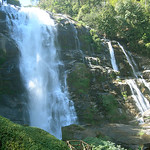
Waterfall : This far down the mountain the
forest is very different to that at the summit. The waterfall
itself is very photogenic, particularly after the wet season.
Blue Whistlingthrush is always present here with at least
two subspecies to be seen in the "winter" months;
Grey Wagtail is often to be seen foraging amongst the torrent.
A little downstream of the falls, where a set of steps leads
down to the stream, Slaty-backed Forktail is usually to be
found but can be shy so be quiet and still. Plumbeous Water
Redstart can also be encountered here but can be very quiet
and often sticks to the shadows, so look closely. White-capped
Redstart will sometimes show up here too if there is no disturbance,
but it is more likely to be spotted on the falls. It is worth
spending an early morning or late afternoon here to see this
bird undisturbed as its colours are wonderfully vivid: this
is one of my favourite birds at Doi Inthanon. Note:
Slaty-backed Forktail is still easy to find here in the wet
season but River Chat and Plumbeous Redstart are absent.
There is a trail up the side of the falls, to the top, which
goes through the forest for a kilometre or so. I have not
spent much time here but species such as Golden-fronted Leafbird,
Puff-throated Bulbul, Large Cuckooshrike, Grey-headed Canary
Flycatcher and Black-headed Bulbul are easily seen.
Km 18 :
A bridge crosses a stream here and the waterfall viewable
to the left, as one heads uphill, is a reliable spot for Slaty-backed
Forktail and Blue Whistling Thrush. Often Striated Swallow
can be seen in flight here and sometimes Dusky Crag Martin
joins them.
Km 13
: A small parking area leads to a bridge over a stream
and then along a road through the dry forest, running steeply
uphill for several kilometres before becoming more undulating
and eventually leading to several small villages. The road
has been completely innappropriately widened by national park
authorities in 2016 (you now know where that 300 baht entry
fee goes) cutting a swathe through the forest and besides
the amount of habitat destruction occurring here it has made
birding even harder than it already was. Work was finished
by late 2018 leaving an extremely ugly and wide scar through
the forest, with piles of construction waste along the length
of the road illustrating what complete numpties the people
in charge of this national park are.
This has been a favourite place to look for Rufous-winged
Buzzard, Black-headed Woodpecker and White-rumped Falcon over
the years although they are by no means assured due to the
excessively low levels of bird activity along here, even in
the early morning.
Black-headed Woodpecker is an extremely attractive bird which
is fairly numerous in this area although quiet and inactive
for much of the time; other woodpeckers here include Grey-capped
Pygmy, Common Flameback and White-bellied. Species such as
Golden-fronted Leafbird, Sooty-headed Bulbul, Purple Sunbird
and Lineated Barbet are likely and raptors also include Collared
Falconet and Black Baza. Black-backed Forktail inhabits the
stream at the Km 13 parking area and can be seen in the mornings.
This road can be punishingly hot from about 9.30am and totally
devoid of birds; I have had the best luck in the early morning
and an hour before dusk, after 5.30pm, in areas with the most
mature and spaced out trees.
Mae Klang
Falls: This area can be worth investigating
early in the morning before the heat becomes too much or too
many people turn up. Greater Racket-tailed Drongo is very
obvious here and I have also seen Banded Kingfisher at this
point. On one fortunate occasion the very beautiful Black-headed
Woodpecker put in an appearance for me here but it is not
usually considered one of the main birding hotspots.
Parakeet
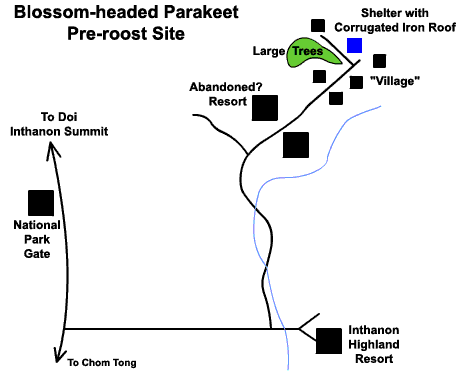
Pre-roost: About 3 kilometres from the Inthanon
Highland Resort is an area of large scattered trees which
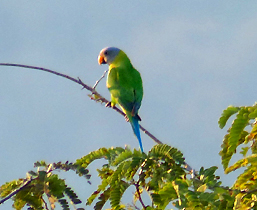
is a regular pre-roost gathering for Blossom-headed Parakeets
in the dry season. The highest number I have counted is at
least 60 birds and I have heard of reports of more than 100.
This spot is also good for Rufous Treepie, Indochinese Bushlark,
Striated Swallow and a number of other dry open-country species;
in fact a surprising number of species can be added to your
trip list here.
Not to Scale
Blossom-headed Parakeet
To get there, turn left towards the "parakeet conservation
area" a little before the Inthanon Highland Resort. Turn
right before reaching the conservation area and over a small
bridge, turning left as you pass over it. Go through an abandoned
resort and continue a few kilometres until the scattered houses
which form a village. At a small left hand turning you will
see an obvious shelter with plenty of space to park in front
of it.
Wait for the birds to arrive in the trees marked on the map.
Between 5pm and sunset is the time when the parakeets will
arrive and form flocks before heading off to their roost site.
Facilities
Although there is quite a range of accommodation here it
ranges from grubby to adequate within the park itself, with
better quality just outside. Two locations within the park
have National Park bungalows; park HQ and Mae Pan. At HQ the
bungalows appear to cater for large parties, and although
I have never stayed here, I was told that bungalow prices
started from 800 baht per night - some look quite nice. However,
good luck dealing with the booking system for these and I
would recommend not bothering to stress yourself out with
this and stay somewhere else. HQ also has a large restaurant
for diners, which serves good food from a menu with an hilarious
list of spelling errors!
The campsite is also located near headquarters, but far enough
away from it to be inconvenient; remember to pack a torch
for the walk back from the restaurants in the evening or possibly
food can be found in the hill-tribe village. There are toilets
and showers here, but these can feel just a little chilly
and during busy periods it can be quite noisy too. The nights
here can be surprisingly cold so make sure to bring sufficient
bedding if camping otherwise a good night's sleep will be
difficult to come by as I found out rather dangerously in
1999: Doi
Inthanon Trip Report.
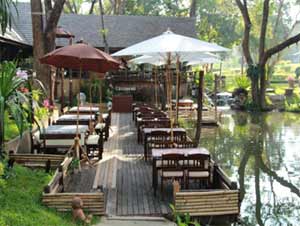
Also near HQ is Mr Daeng's where he has a few, simple and
cold, rooms for rent. Food is available here from early morning
until 7.30pm and there is a bird log which can be quite informative
(but often many misidentified birds) and he has copies of
his birding map available. It's worth coming here for lunch
at least once just to see the vast array of excellent bird
photos on the walls. I recommend his green curry, but would
avoid the spring rolls.
The National Park bungalows at Mae Pan are ok and can be rented
for lower prices than at HQ due to the lower number of visitors
here and have the benefit of hot showers; I stayed here in
the past without booking, I just asked if there was availability,
and there was. There used to be a small restaurant here
but last time I visited it was closed.
At approximately kilometre 26 there is a turn off towards
a hill-tribe village where there are now a number of fairly
pleasant-looking places to stay, located in a peaceful spot.
There are also a number of local restaurants here so no need
to go hungry. Mr Boontham has some accommodation here that
he and his wife run - Rang
Bon Doi. They are a very pleasant couple and
Boontham has some nice birds viewable from his hides in the
nearby forest for birders to visit
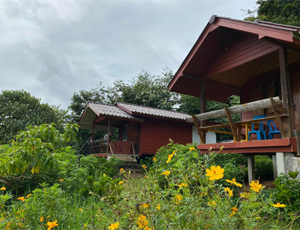
At Siriphum Waterfall Khun Yi and his wife run a pleasant
set of accommodation consisting of good quality cabins.
Other facilities in the park include excellent hot chocolate,
tea and coffee at the summit (and don't eat all their delicious
chocolate brownies, leave some for me) with souvenirs for
sale along with postcards stamps and a postbox so you can
send something home from Thailand's highest point in the old-fashioned
stylee. Pot noodles and other simple snacks are also sold
from a few kiosks and the military checkpoint; in the colder
months someone is usually selling a lovely ginger infusion
from a cauldron at the military checkpoint. Simple food, snacks
and drink are available at the Gaew Mae Pan car park and at
the 2 chedis with barbecued chicken and ice-cream at Vatcharitan
waterfall. In the rainy season the stalls at Vatcharitan waterfall
are usually closed though.
By far the nicest accommodation is outside of the national
park with the Inthanon
Highland Resort being a particularly pleasant place
to stay, but perhaps a little over-priced at 1600 baht per
night. They are used to catering for birdwatchers and will
have breakfast ready early in the morning - the food here
is very good. Sometimes this place gets very busy with birding
groups, but there is also an equally good alternative next
door; Touch
Star Resort. Just around the corner from these
places is MTT
Resort which has pleasant enough rooms in a quiet
area, although breakfast is not early enough for birders and
there is no restaurant here; you can easily drive the short
distance to Inthanon Highland Resort and eat in the restaurant
there. Along the road from Chom Thong to the park entrance
is an ever-growing number of places to stay which may or may
not suit bird watchers. The National Park staff will charge
visitors the 300 baht entrance fee on a daily basis if staying
outside of the park unless you are informed that the tickets
are valid for three days! Consider yourself informed.
Nearby Chom Thong has a number of shops and fuel stations
where most supplies can be found - there is even a small Tesco
supermarket now where a large range of supplies can be found.
There are also cash machines in the town should you run short
of money! There is also a 7/11 store a couple of kilometres
along the Doi Inthanon road from Chom Thong with an ATM and
various snacks.
Chiang Mai, where most visitors to Doi Inthanon will stay
for at least a short period, has lots of excellent places
to stay and eat. A good hotel in Chiang Mai is the Amora
Tapae. This is a very comfortable hotel with ample
parking and an excellent breakfast buffet which begins at
6am (if you get there a bit earlier the food is ready and
they will let you in) and it is also convenient for walking
to many of Chiang Mai's most famous temples and the Sunday
night market. Hotel
M (small parking area, breakfast buffet) and Hotel
Imm (plenty of parking, breakfast buffet) are both
similar hotels in the same area.
The entrance fee to this National Park is 300 baht per person
for foreigners plus 30 baht for your vehicle, but as of November
2022 the entry tickets are valid for 3 days and there is no
need to buy a new ticket every day.
Thrushes This lovely book covers all of the thrushes in the
world and is a useful reference for anyone hoping to
see some migratory thrush species in northern Thailand.
Beautiful plates by Ren Hathaway are accompanied by
insightful and extensive species accounts.
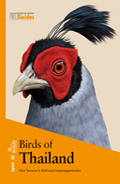
Birds
of Thailand This field guide has set new standards in identifying
birds in the wild in Thailand. With the most up-to-date
taxonomy of any publication this is the book you need
if you are birdwatching in Thailand. Forget all of the
older guides and buy this one.
Bird
Watching Trips:
Doi Inthanon is a must-visit site for your northern Thailand
bird watching itinerary for a large number of colourful
species and some great birding in beautiful forest. Doi
Inthanon always provides good birding and often a few
surprises.










 Download
a full
Download
a full