Even just a quick glance at a copy of any field
guide for the birds of Thailand will alert birdwatchers to
the large number of species present in Thailand and, indeed,
those making their first trip to the country may be excused
for thinking that they will get off the plane and be bombarded
by a vast array of colourful and exotic birds. Unfortunately,
this is not the case and many birders have commented on what
they perceived to be a general lack of birds. Although to
many European visitors there can appear to be a lack of birds,
particularly gulls and ducks which are so common in many northern
latitudes, Thailand is in fact blessed with a particularly
rich avifauna and, in contrast to many Asian nations, birds
outside of protected areas are relatively abundant.
A combination of the unfamiliar climate and vegetation is
to blame for many visiting birdwatchers finding birds so difficult
to locate, with intense heat during the day making birds very
hard to find outside of the dawn and dusk periods of peak
activity and dense vegetation with a high canopy making it
difficult to spot birds even when they are close by.
Here I have attempted to give ten tips that will help birdwatchers
make the most of their stay in Thailand and identify as many
species as possible.
1. Be familiar with the species:
Knowing what to expect can help when presented with a large
number of new species in a short space of time; this is particularly
important when watching mixed feeding flocks of small birds
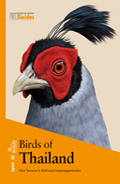
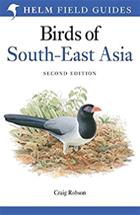
in forests. Buying a copy of Birds
of Thailand published by Lynx Edicions well in advance
of travelling to Thailand will give birders time to study
the species likely to be seen and to become familiar with
the habitats that they occur in, as well as becoming familiar
with the layout of the book itself. The distribution maps
in both books are useful for giving birdwatchers some indication
of which species are likely to be encountered and where the
may be found. It is far too difficult to become familiar with
all of the birds but it is a good idea to get to grips with
the names so that and the general shape, size and structure
of some of the more widespread groups of birds such as warblers,
flycatchers, bulbuls and laughingthrushes. Becoming familiar
with some of Thailand's commonest birds is also a very good
idea, you can start by reading this article - Common
Birds from the Car Window in Thailand.
Browsing through the birding
locations pages here on thaibirding.com will also give
you an indication which are the key species for each birding
site and the checklists
should also provide some valuable infomation, although most
of the lists are far from complete.
2.
Get to a good location: Thailand has a lot
of National Parks and Wildlife Sanctuaries and these are generally
good locations for birdwatching. Although illegal hunting
and encroachment occurs in most of the country's protected
areas, generally, sufficient habitat remains and hunting pressures
are low enough for birds to remain abundant.
In many rural parts of Thailand birds can still be found in
good numbers even outside of protected areas. Where farming
and aquaculture is extensive enough to create diverse habitat
patchworks, a good number of bird species can often be found.
Temple grounds can often be good places to look for birds
as large, mature trees often remain within them and hunting
is forbidden.
A number of farmers around the country have retained wild
patches of ground and waterbird colonies have thrived within
these. Indeed, large waterbirds appear to be making something
of a comeback as hunting pressures subside. Traditionally
farmed rice fields are often good birding sites although some
birdwatchers make the mistake of expecting to see large numbers
of bird species in areas such as rubber and palm oil plantations;
these areas are very poor in species, similarly to monocultures
in other parts of the world.
3. Get up early: The
importance of this cannot be overstated: the sun rises between
6 and 7 am and by 9.30 to 10.30 am bird activity, particularly
in forests, has noticeably decreased. Don't make the mistake
of having a lie-in and going birding after a sedate breakfast
- you will see very little and become uncomfortably hot, giving
yourself a very small time window in which t see birds. The
period before dusk (about 2-3 hours before sunset) can also
be good for birdwatching, but the level of bird activity rarely
becomes as intense as the early mornings in forest areas although
in rice fields and wetlands this time of day can be excellent.
Having said this, birders who stay out all day will see more
species than those who retire for an afternoon nap, and by
getting to a good raptor watch site or wetland, the most can
be made of the afternoon period. Be sure to take plenty of
water and sunscreen!
4. Learn some bird calls:
With such a huge number of species present, and the skulking
nature of many of them, it is important to learn the calls
of some species. Obviously it is not practical to learn all
the bird calls before visiting Thailand but it is a good idea
to learn the calls of a small number of the commoner birds
and some of your main target species.
Using recorded bird calls can be an effective way of finding
some difficult species, but quite frankly, at some locations
in Thailand this practice has become quite abused. I'm told
that using call playback at a stake-out for Rusty-naped Pitta
near Malee's at Doi Chiang
Dao became such a problem that eventually the bird abandoned
its territory. Please be sparing in this practice and completely
refrain from doing it at stakeouts and hides that receive
large numbers of other birdwatchers.
5. Be quiet and vigilant:
Birding in tropical forests can be really frustrating at times
and it is possible to walk for an hour without seeing anything.
Walking slowly and quietly will help birders locate species
as it is easy to detect movements by ear or sight. However,
it is a good strategy to occasionally stop and wait for birds
to come into view, particularly in an area where there may
be a good food or water source.
When walking it is good practice to lift one's feet at each
step to avoid making noisy rustling sounds and of course,
if birdwatching in company only speaking in low voices is
usually okay. Loud noises and sharp movements are very disturbing
to forest birds and this type of behaviour will result in
fewer quality sightings.
Occasionally, it is advisable to walk briskly, but quietly,
along a trail in order to surprise species that become aware
of your presence very quickly, even when quiet.
6.
Look out for fruiting and flowering trees: In forests
in Thailand flowering and fruiting trees can be a fantastic
opportunity to watch a large variety of species in one location.
If a suitable tree is found it is a good strategy to just
sit and watch what is visiting; rarely does one have to wait
long for something of interest to show up.
Flowering trees can attract large numbers of drongos, barbets
and bulbuls and banana flowers are favourites of spiderhunters
whilst fruiting trees are often the feeding places of hornbills
and green pigeons; pittas and pheasants sometimes feed on
fallen fruit too. Creeping up to a fruiting tree and watching
from below will sometimes reward observers with sightings
of large mammals too, such as gibbons, langurs and civets
in addition to being a good way of finding birds.
Some ancient temple grounds have trees that produce fruit
too and large flowering trees in open country can also attract
some interesting species. Often large numbers of mynas visiting
these types of trees are what will alert birders to the presence
of an interesting flowering tree.
7. Wear the right clothes: Wearing
appropriate clothing will help birders remain comfortable
and devote more energy and attention to finding birds. Long-sleeved
cotton shirts are advisable for dealing with sweat and preventing
insect bites. Similarly, canvas trousers are suitable for
walking through grasslands and forest (avoid shorts), and
army trousers are particularly good at drying quickly, even
in humid atmospheres. In the rainy season leech socks are
an excellent addition to the birder's wardrobe; although lecches
are harmless they are fairly unpleasant and can prove a real
distraction in some lowland forest regions, most notably Khao
Sok and Hala-Bala.
It is also very important to wear the right colours. Vegetation
in tropical forests is dark in colouration and bright clothing
will be spotted quickly by shy birds. Many birders visit Thailand
and wear pale, stone-washed colours that are probably just
fine in temperate climates but in a shady forest they stand
out like a beacon. Many species are shy and even if they approach
you it is likely they will fly away qucikly when they see
you in pale clothing.
8. Carry an umbrella:
An umbrella is a useful tool for birdwatchers in Thailand.
Umbrellas can be used to give shade from the sun in exposed
areas as well as protect from the rain. Some people will opt
for coats of some design to avoid a soaking but the disadvantage
is that the hoods obstruct hearing and create rustling noises
that can be mistaking for foraging birds. An umbrella with
a hook at the handle's end is best as it can hook onto a day
pack and this type is also sturdy enough to be used for bashing
unruly dogs or moving spiky vines aside.
9. Don't get lost:
Rather an obvious statement, but sticking to well-worn trails
can be good practice as these are usually free from fallen
leaves and twigs that will make a noise when walking. Following
streams or gulleys can be very useful as some secretive species
stick to these areas and they are easily followed. However,
stepping off the main trail in forested areas can result in
getting lost remarkably quickly as vegetation can be extremely
dense. If one gets lost in this fashion then it can take ages
to find one's way and by then the best of the day's birding
has passed.
Sticking to main trails also reduces the likelihood of wandering
onto private land and getting into trouble. Although not many
birders visit these regions of Thailand it should be remembered
that there are still landmines in forest along the Thai-Cambodia
border and Thai-Laos border. Stay on the trail!
10. Submit your records:
By submitting your records this knowledge can be collated
and the data used to further ornithology and conservation.
Additionally, these records are sent to the Bird Conservation
Society of Thailand for their records.
There are very few sightings submitted between the months
of May and November, so almost anything from this period is
of interest.
These are just ten useful ideas that will help birders enjoy
their experience in Thailand, but I'm sure there are more.
If anyone has anything to add to this list please e-mail me
with your suggestions and I will happily add to it.
Bird
Watching Trips in Thailand:
Sometimes assistance by local experts is the best way
to enjoy a birding trip in Thailand. These experts will
be able to take you to the best birding sites, at the
right times and have an excellent knowldege of bird calls.
Good
Birders Don't Wear White is an amusing but informative
book that uses the anecdotes of some of America's most influential
birders to impart best birding practice to the reader. There
are tips on pishing, pelagic birding, cleaning binoculars
and many other birding-related topics.



 2.
Get to a good location: Thailand has a lot
of National Parks and Wildlife Sanctuaries and these are generally
good locations for birdwatching. Although illegal hunting
and encroachment occurs in most of the country's protected
areas, generally, sufficient habitat remains and hunting pressures
are low enough for birds to remain abundant.
2.
Get to a good location: Thailand has a lot
of National Parks and Wildlife Sanctuaries and these are generally
good locations for birdwatching. Although illegal hunting
and encroachment occurs in most of the country's protected
areas, generally, sufficient habitat remains and hunting pressures
are low enough for birds to remain abundant.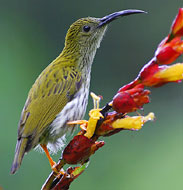 6.
Look out for fruiting and flowering trees: In forests
in Thailand flowering and fruiting trees can be a fantastic
opportunity to watch a large variety of species in one location.
If a suitable tree is found it is a good strategy to just
sit and watch what is visiting; rarely does one have to wait
long for something of interest to show up.
6.
Look out for fruiting and flowering trees: In forests
in Thailand flowering and fruiting trees can be a fantastic
opportunity to watch a large variety of species in one location.
If a suitable tree is found it is a good strategy to just
sit and watch what is visiting; rarely does one have to wait
long for something of interest to show up. 


 Download
a full
Download
a full