Benjakitti Park
(Updated 29/03/26) |
Introduction |
|
Benjakitti Park, in Bangkok, is the
newest of the large parks in central Bangkok having formerly
been off limits to most people as the grounds of the Thailand
Tobacco Monopoly. Having been relandscaped, but retaining
a large number of mature trees, this is now a park with areas
of rough wetlands that are overlooked by a series of aerial
walkways and interesected by pathways. The section of Bejankitti
Park adjacent to the lake was opened to the public some time
ago but the large extension, which is now known as Benjakitti
Forest Park, was fully opened to the public in 2022.
The attractive landscaping and elevated walkways attract plenty
of people to the park in the mornings, particularly at the
weekends, but Bejakitti Park is also building a reputation
as one of the best birding spots within the city centre. There
is an interesting selection of resident birds here, a rather
more diverse set of breeding birds than other city parks due
to the wetlands areas, and an ever-increasing list of interesting
passage migrants in spring and autumn.
As an urban greenspace escape from the hustle and bustle
of the city Benjakitti Park is a pleasant place for birders
to visit with a non-birding partner as well as providing a
great place for a morning for birders staying in the nearby
tourist accommodation hotspot of Sukhumvit Road. |
|
|
Birding Highlights |
|
Benjakitti Park is a good place for visitors to Thailand
to familiarize themselves with a variety of Thailand's more
common species at any time of the year but it is during migratory
periods that there is the most potential to see the highest
number of species.
A checklist of the birds for this location can be found here
- Benjakitti
Park Bird Checklist |
 |
Travel Information |
Use the interactive map below to plan your route to
Benjakitti Park. The blue line shows the route from Sukhumvit
Road (A) in downtown Bangkok to the car parks at Benjakitti
Park (B & C). |
|
On Foot
It's quite likely that you will be staying in a hotel nearby
if you are a visitor to Thailand so just walk to the park.
Don't forget though, that in very hot weather even fairly
short distances can seem like a long way; particularly on
the return journey.
By Car/Motorcycle
If arriving by car or motorcycle there are two car parks,one
of which is in the heart of the park. The locations of these
are marked on the map above.
By Bus
There are plenty of buses that pass close to the park. Use
this online tool to find out which bus goes from your location
to the park - Transit
Bangkok - Bangkok Bus Map.
By Taxi
A taxi is a convenient and inexpensive way of arriving at
and departing from Benjakitti Park. When using taxis is Bangkok
make sure that the driver starts the meter; it is compulsory
for drivers to use the meter and if they want to haggle over
the price you can be sure that he or she is giving you an
overinflated price.
Tuk-Tuk/Motorcycle Taxi
Tuk-tuks are not metered so you must haggle over a price which
can be annoying. Tuk-tuks are cheapest for short journeys,
if your journey is a long one a taxi is better, not to mention
safer! Tuk-tuks can be fun to use and the cheaper you get
the fare, the faster and more erratic will be the driving.
Motorcycle taxis are useful if you have to cross the city
in a hurry when it is gridlocked (which is much of the time),
but are extremely unsafe. Fatal accidents involving motorcycle
taxis are not infrequent and I would not advise using this
mode of transport.
By Train
The skytrain is a comfortable and quick way of travelling
around town; if you are near a station I would recommend using
this method to get to Benjakitti Park. Tickets are available
at the stations from machines or staff. Details of the Skytrain
(BTS) can be found here - Bangkok
BTS Map & Info. The nearest skytrain stations are
Nana and Asoke. There are also two underground (MRT) stations
close to the park, Asoke and Queen Sirikit Convention Centre.
Details of the underground (MRT) can be found here - Bangkok
MRT Map & Info.
|
 Bird
Watching Trips: Bird
Watching Trips:
If you need help organizing a bird watching trip to Thailand,
take a look at the suggested itineraries for ideas on
creating a tailor-made trip and contact me for advice:
Thailand
bird tours. |
|
Finding Birds |
A large number of species can be found at Bang Poo at the
right time of year, and due to the small size of the site
most of these can be easily found. There is always potential
to add to the site list, with unusual migrant species showing
up every year with some surprising species having been seen
over the years.
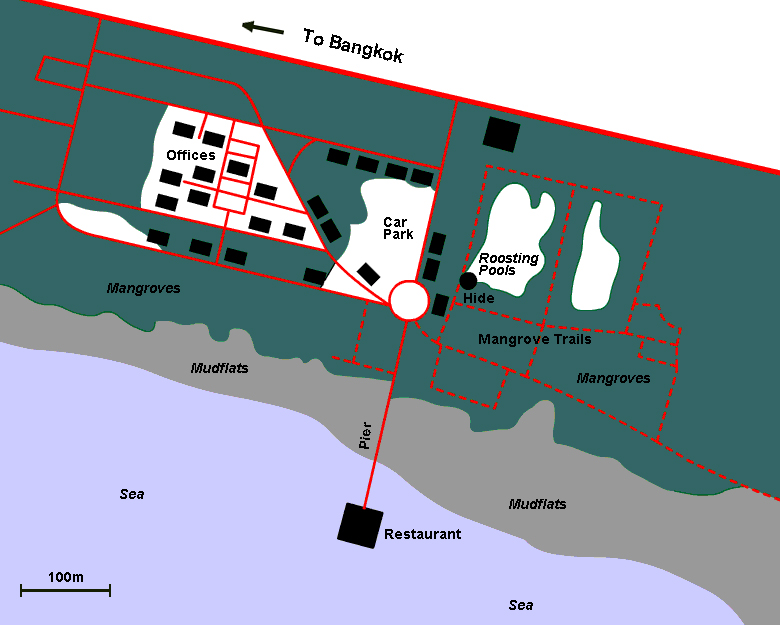
Most bird watchers come here to see shorebirds and indeed
many species in this group are easily observed on the mudflats
at low tide (view from the pier) and on the inland pools at
high tide.
However, it is also worth taking a walk around the site where
a lot of common open-country species can be found as well
as a number of interesting migrant species. The Spring migration
tends to produce the richest pickings in terms of unusual
migrants here, with Grey-tailed Tattler often seen in small
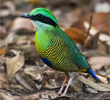
numbers in April and early May as well as Blue-winged Pitta
and a whole lot of other passerines passing through.
There are a number of spots around Bang Poo where bird watchers
are likely to make the most interesting observations;
Mudflats:
The pier provides the best place to observe birds on
these mudflats and as with any shorebird watching getting
the tide at the right time is important or the birds can be
distant specks (tides can be found here: My
Forecast, Marine Reports); it is important to have a telescope
here although if you are present when the tide is just going
out or coming in birds do come quite close. Large numbers
of Black-tailed Godwit are usually found here and other commoner
shorebirds here include Pacific Golden Plover, Common Redshank,
Kentish Plover, Marsh Sandpiper and Common Greenshank with
species such as Tibetan Sand Plover, Greater Sand Plover and
Red-necked Stint usually present too.
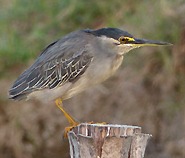
Striated Heron
|
|
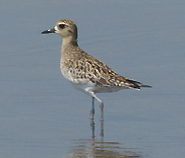
Pacific Golden Plover
|
|
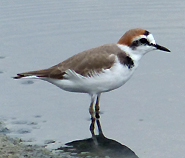
Kentish Plover
|
|
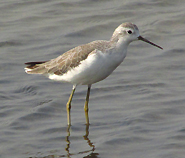
Marsh Sandpiper
|
| (Photos by Nick
Upton) |
Terns can be observed closely from the pier too as they either
roost on mudflats and/or bamboo poles or fish over the shallow
waters. In April it is a great place to get really close views
of Whiskered and White-winged Terns in breeding plumage as
they cruise alongside the pier.
Lines of bamboo poles encourage sedimentation and prevent
erosion and these are appreciated by roosting gulls, terns
and Collared Kingfishers as well as Black-capped Kingfisher
during the dry season. Great and Little Egrets are common
on the mudflats as are Little Herons and a Brahminy Kite or
two can usually be seen and Painted Storks are seen more and
more frequently too.
The pier is also the best place to observe the gulls that
make Bang Poo famous among Thai people. Between October and
April large numbers of Brown-headed Gulls can be seen at close
quarters and there are always a few Black-headed Gulls too
which can be tricky to pick out. In most years a few Slender-billed
Gulls join the flock too and over the course of the years
all sorts of gull rarities have shown up; check the gull flock
carefully.
Although the Gulf of Thailand has few seabirds other than
gulls and terns, in recent years boat trips into the Gulf
in April/May have discovered some species of interest and
with the right winds the pier at Bang Poo may be a good spot
to look for such birds - I have seen Great Cormorant out to
sea here and Bridled Tern at this migratory time of year and
Frigatebirds occur ocassionally.
Roosting
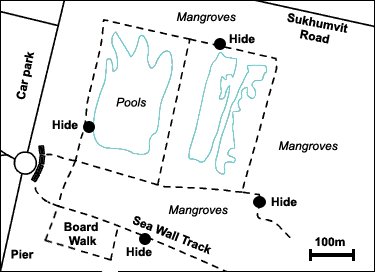
Pools: In an area where the land adjacent to
the sea is dominated by industry, this small area of coastal
pools is important as a high-tide roost for many of the area's
wading birds. This area has been designated as a nature reserve
and has a number of hides for viewing the birds on the pools;
it is fenced and sometimes the main gate it locked but don't
worry because there is another rickety wooden gate at the
rear of the adjacent building that is always open.
 |
|
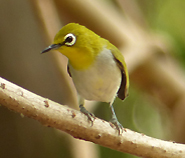
Swinhoe's White-eye |
|
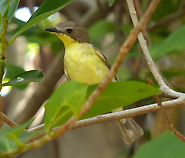
Golden-bellied Gerygone |
| (Photos by Nick
Upton) |
A large flock of Eastern Black-tailed Godwits always gather
here at high tide and sometimes it is possible to find one
or two Asian Dowitchers within their midst - their thick,
black bill stands out in the crowd. Species such as Wood Sandpiper
and Long-toed Stint favour this habitat at all times, rarely
venturing out onto the mudflats. Other shorebird species that
can be seen at close range here, while roosting, include Curlew
Sandpiper, Red-necked Stint, Marsh Sandpiper, Pacific Golden
Plover, Common Sandpiper and breeding Black-winged Stilt.
The trails and the new mangrove boardwalk in this area allow
birders to look for small passerines such as Oriental White-eye,
Dusky Warbler, Ashy Minivet and Golden-bellied Gerygone; a
number of other species may be found during migratory times
including some great birds such as Yellow-rumped Flycatcher
and Blue-winged Pitta.
A track also goes along the sea wall here and it is a good
place to sit quietly as the tide comes in and watch the shorebirds
as they gradually get closer; there is a hide here to help
birders with this.
Mangrove
Trails: A combination of paved tracks, dirt
tracks and boardwalks (some of which are in a poor state of
repair) give birders access to the largest area of remaining
mangroves. Golden-bellied Gerygone is very numerous here and
its high-pitched whistle can often be heard coming from any
of the many mangrove fragments. It can be quite a difficult
species to observe due to its tiny size and colouration, but
be patient and you are sure to eventually obtain good views
perhaps alongside Swinhoe's White-eye. In the early morning
and late afternoon Pink-necked Green Pigeons perch on exposed
branches in this area while Blue-tailed Bee-eaters use the
same perches for hunting from. Walking these trails in migratory
periods is likely to turn up species such as Square-tailed
Drongo Cuckoo, Yellow-rumped Flycatcher, Eastern Crowned Warbler,
Mugimaki Flycatcher and many others while Ashy Drongo, Asian
Brown Flycatcher and Dusky Warbler are common "winter"
visitors.
Offices:
In this area ther |
| |
Facilities |
 |
Set in the heart of Bangkok there is everything one could
possibly need within a short walk of the park. A countless
number of hotels, for all budgets, are just a short walk away
along Sukhumvit Road where there are also many restaurants,
some supermarkets, hospitals, pharmacies, convenience stores
etc.
Within the park itself there are a number of clean public
toilets, two car parks, several places to play indoor sports
such as badminton, bike rentals and a running track around
the lake. However, there are no kiosks selling food or drinks
although there a re couple of small shops doing so very close
to the park gate that accesses Sukhumvit Soi 4.
|
Related Birding Videos |
|
Other Related Pages |
Benjakitti
Park Bird Checklist
Birdwatching
Day Trips from Bangkok
Other Central Thailand Birding Locations
The
Birds of the Bangkok Area |
Books I Recommend |
 How
Birds Migrate How
Birds Migrate
This is one of the most informative books on birds
that I have ever read. Covering all aspects of bird
migration this is a great read for broadening your knowledge.
There are usually some cheap second-hand copies available
through the link above.
|
 Birds
of Thailand
Birds
of Thailand
This field guide has set new standards in identifying
birds in the wild in Thailand. With the most up-to-date
taxonomy of any publication this is the book you need
if you are birdwatching in Thailand. Forget all of the
older guides and buy this one.
|
|
Trip Reports |
Bangkok
& Samut Prakan Day Trip, 5th February 2022 - by
Nick Upton |
 |
|
Bird
Watching Trips:
Bang Poo is a good site for a half-day of birding and
makes a nice final stop on any birding itinerary finishing
in Bangkok; great for close-up photos of gulls and there
is always the chance of a rarity here.
View suggested itineraries, Thailand
bird tours, or contact me for more
information: nickupton@thaibirding.com. |
|
Related Blog Entries |
|
Photo Galleries |
Select the thumbnail photos to see larger images. |
|
| Birds at Benjakitti Park
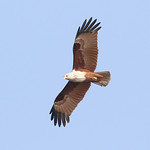
Brahminy Kite |
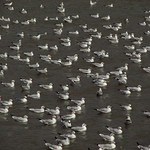
Gull Flock |

Javan Pond Heron |
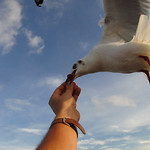
Gull feeding at Bang Poo Pier |
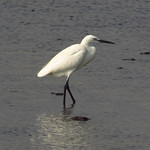
Little Egret |
|
Selected eBird Lists |
|
|
|
|
|
I Hope
You Enjoyed This Page
If you found the information you were looking for here
please let others know by liking this page on Facebook
and Tweeting it.
|
|
|
If you found this page useful and want to say thanks, you
can buy me a beer.
 |
|
|
|





 Download
a full
Download
a full