Introduction In the past I have enjoyed many day trips to Bang
Pra where a good mixture of open-country, grassland, wetland
and even woodland birds can be found; it was always an excellent
place to see quail and buttonquail. However, in recent years
the water levels of the lake have been maintained at very
high levels and have reduced the amount of grassland habitat
to almost zero and the marginal habitat has been severely
degraded by overuse by local people.
I decided to spend a morning at Bang Pra to see whether it
is a location which remains worthwhile for birdwatchers, or
one to forget about.
Additionally, I wanted to go to the waterfront at Sri Racha,
where some years ago I had seen Black-naped Tern, to check
if that species was still present there.
Getting There
I used a hire vehicle that I was in possession of, but any
vehicle would be suitable for this journey as all the roads
are good. I took the expressway out of Bangkok and headed
towards Suvarnapoom airport. When getting close to the airport
I followed the signs to Chonburi via the "motorway"
(signposted as such in English). I followed this until it
split into two; the turning being either for Chonburi or Pattaya
- the Pattaya turning is the one to take. After several more
kilometres signs for Khao Khieo open zoo and Bang Pra appear
and follow the instructions as given in the page dealing with
Bang Pra Reservoir.
To get from Bang Pra to Sri Racha, I just went back to the
motorway, headed south and followed the signs to Sri Racha.
When at Sri Racha waterfront head for the public pier where
you can park.
Accommodation
I did this as a day trip from Bangkok, but if you should wish
to stay in the area there are many places to stay on the coast
at Bang Saen, Ang Sila, Sri Racha or Pattaya.
Food
At Bang Pra itself there is no food. However, if one just
drives back to the motorway and over it, there is a passable
small restaurant on your right. I had lunch on the pier at
Sri Racha where lots of seafood dishes are available very
cheaply. Food and drink is safe at any roadside foodstall
or restaurant in Thailand.
Bird Calls
I had only used call playback once on this short trip; for
those that need call recordings, they are available here:
Xena
Canto.
Bang Pra : Greater Painted Snipe, Rosy Starling, Laced
Woodpecker, White-crested Laughingthrush, Siberian Rubythroat,
Rain Quail, Yellow-legged Buttonquail, Black Bittern, Cinnamon
Bittern, Oriental Darter, Crow-billed Drongo, Yellow-eyed
Babbler. Sri Racha : Black-naped Tern.
Notes
I left Bangkok at a little after 5am and arrived at Bang Pra
for first light at around 6.15am. Driving along the road which
encircles the site I saw a lot of activity on the overhead
wires and trees. Stopping briefly I saw a male Laced Woodpecker,
several White-crowned Laughingthrushes, some Greater Racket-tailed
Drongos, a Rufous Treepie and a Lineated Barbet - a very pleasant
start to the day.
However, when I drove down the dirt track to where I usually
park the car, near some sort of staff compound, the gate was
locked. Although this was a bit strange I found space enough
to park (I discovered on a subsequent occasion that the staff
were concerned about vandalism. When they saw me they opened
the gate for me and told me in future to let them know I wanted
to park and they would unlock the gate).
The next thing that I discovered is that the mud wall between
the main lake and the small lake has been breached and the
water level in each is the same, meaning that water levels
in the main lake are very high, leaving most of the former
grassland habitat inundated; this was a disappointment. So
far things seemed to have taken a turn for the worse at Bang
Pra.
From the parking area I walked north along the track and then
along the paved trail to where I used to see plenty of grassland
birds, including quail. The situation was a mess! No grass
existed at all, the whole place was flooded and with overuse
by the locals the margins were extremely trampled and littered.
The next area I knew that might have some suitable habitat
was a long walk, so I turned around and looked elsewhere.
Back at the car I walked along the paved trail southwards
around the small lake. This takes you through a wooded area
where I saw a few Black-naped Orioles, Racket-tailed Treepie
and Greater Racket-tailed Drongo. This trail soon came out
onto the southeastern edge of the main lake where I was greeted
with the sight of reedy pools, grassland, scrub and marginal
wetlands - hey, it looked like I might find some birds after
all!
Bird
Watching Trips:
If you only have a short time for birding from Bangkok,
Bang Pra is an excellent site to visit as part of a
day trip and is the best location for birding if staying
at nearby Pattaya. Combine this site with a visit to
Muang Boran Fishponds, Lat Krabang Rice Fields and/or
Bang Poo for a good day's birding. At all times of the
year a good selection of interesting species can be
seen.
Contact me to arrange a birding trip and/or to discuss
the best bird watching options for you: nickupton@thaibirding.com
I walked
off the trail a little into some good habitat and the birds
began to come quickly; Yellow Bittern, Cinnamon Bittern and
Black Bittern all showed quite soon and a Siberian Rubythroat
in the tangles soon came out after a little call playback.
Just standing in one place with a good view I soon spotted
some Chestnut-capped Babblers showing nicely in the waterside
vegetation as well as Oriental Reed Warbler and Black-browed
Reed Warbler; all birds I expected to see at this site. However,
a bird I did not expect to see was perched in a bare tree
about 100 metres away, giving me good views through my telescope
- a Rosy Starling in breeding plumage! This is quite a rare
visitor to Thailand so when it was joined by 2 more I was
even more surprised. I eventually got much closer and got
excellent views of the three of them.
The remainder of the morning continued in the same vein with
many good birds around and it brightened up my mood regarding
the situation at Bang Pra. Although there has been much degradation
of the habitat, many interesting birds are still to be found,
one just has to look a little harder and move around a little
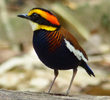
more than in the past. I found several Painted Snipe, Pheasant-tailed
and Bronze-winged Jacanas, 2 Oriental Darters sat in a bare
tree, Bright-headed Cisticola, Yellow-eyed Babbler and a number
of other interesting species. However, I still had not found
any habitat that looked like it would hold a quail.
However, my luck was about to change; as I took a short cut
across a dry grassy area I noticed some movement next to a
bush. I managed to get my binoculars on the source of the
movement and got a brief but clear view of a pair of Barred
Buttonquail. This piece of grassland was right next to the
circular paved trail around the small lake and raised above
the marshy areas, making it much drier and ideal habitat for
some quail, so I slowly walked around it in search for some
other species.
It turned out that I was right, and I managed to get a good
view of a single Yellow-legged Buttonquail and some a few
more Barred Buttonquail before I flushed a Rain Quail from
its hiding place; it was kind enough to land on a bare piece
of ground for a few moments where I could see it briefly.
So, Bang Pra still holds buttonquail and true
quail, they are just harder to find than in the past and,
no doubt, far less numerous than before due to reduced habitat.
In fact, the good number and selection of species seen in
a shirt space of time means that Bang Pra is still an excellent
location for a morning's birding.
After this success I decided to investigate other parts of
the lake by car. Quite frankly, the high humidity and heat
at Bang Pra is always an issue and I was happy to get into
an air-conditioned vehicle for a while. I drove round to the
southernmost tip of the lake. Here there was an obvious route
into a grassy area with some marginal habitat and a sensible
place to park next to the road.
Walking into this area it soon became obvious that although
the habitat here had potential, it was dreadfully overused
and suffering from habitat degradation. However, I quickly
caught up with a few species that I had not seen earlier in
the morning - lots of Indochinese Bushlarks and Oriental Pratincoles.
Investigating this area was interesting and much earlier in
the morning it may have turned up more species but I did manage
to find Baya Weaver, some Yellow Wagtails, a few species of
waders and a few Paddyfield Pipits before I became too hot
and headed off to Sri Racha!
Birding at Sri Racha consists simply of using a telescope
to observe distant terns and gulls flying around and loafing
on the numerous floating constructions, using the pier as
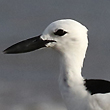
a base. After some time scanning I saw what looked like snowy
white Black-naped Terns sitting amongst some Whiskered Terns.
I walked to the island and got myself as close to these birds
as could where I could get a decent look at 3 Black-naped
Terns, a species which is seldom seen from the mainland in
the Gulf of Thailand.
1. Rain Quail: 1
seen briefly in grassland at BP. 2. Yellow-legged Buttonquail: 1
in grass at BP. 3. Barred Buttonquail: 5 or 6
seen well in grassland at BP. 4. Little Grebe: A few, BP. 5. Laced Woodpecker: 1 in fringing
woodland, from the road, BP. 6. Lineated Barbet: A few, BP. 7. Coppersmith Barbet: 1,BP. 8. Common Kingfisher: A couple,
BP 9. White-throated Kingfisher: Common,
BP. 10. Black-capped Kingfisher: 1,
BP. 11. Green Bee-eater: A few, BP. 12. Blue-tailed Bee-eater: 5,
BP. 13. Lesser Coucal: 2 in grass,
BP. 14. Greater Coucal: A few, BP. 15. Plaintive Cuckoo: 1 adult,
BP. 16. Asian Koel: Common, BP. 17. Green-billed Malkoha: 2 at
BP. 18. Indian Roller: A few by the
roadside, just before entering BP. 19. Eurasian Hoopoe: A few, BP. 20. Germain's Swiftlet: A few
at BP. 21. Asian Palm Swift: Numerous
at BP. 22. Fork-tailed Swift: A
few, BP. 23. Brown-backed Needletail: 2
at BP. 24. Feral Pigeon: Both
locations. 25. Spotted Dove: BP. 26. Peaceful Dove:
BP. 27. White-breasted Waterhen: A
few, BP. 28. Greater Painted Snipe: 6
at BP. 29. Pheasant-tailed Jacana: 3
at BP. 30. Bronze-winged Jacana: 1
at BP. 31. Common Greenshank: A
few at BP. 32. Wood Sandpiper: 5
at BP. 33. Black-winged Stilt: Common
at BP. 34. Little Ringed Plover: A
few at BP. 35. Oriental Pratincole:
c12, BP. 36. Red-Wattled Lapwing:
Common, BP. 37. Brown-headed Gull:
100+ at SR. 38. Black-naped Tern:
3 at SR. 39. Common Tern: A
few, SR. 40. Whiskered Tern:
Common at SR. 41. Western Osprey:
1 at BP. 42. Oriental Darter:
2 at BP. 43. Little Cormorant: Common
at BP; a few at SR. 44. Little Egret: BP & SR. 45. (Eastern) Great Egret: BP
& SR. 46. Intermediate Egret: A few,
BP. 47. Eastern Cattle Egret: BP. 48. Purple Heron: A
few at BP. 49. Chinese Pond Heron: Both
locations.
50. Black-crowned Night Heron:
BP. 51. Little (Striated) Heron:
1 at SR. 52. Yellow Bittern: Several at
BP. 53. Cinnamon Bittern: 2 at BP. 54. Black Bittern: 1 at BP. 55. Asian Openbill: 50+ at BP. 56. Brown Shrike: A
few, BP. 57. Long -tailed Shrike:
2 at BP. 58. Black Drongo: Many
at BP. 59. Ashy Drongo: 2
at BP. 60. Crow-billed Drongo:1
at BP. 61. Greater Racket-tailed Drongo:
Several, BP. 62. Eastern Jungle (Large-billed) Crow:
Both locations. 63. Rufous Treepie:
A few at BP. 64. Racket-tailed Treepie:
Several, BP. 65. Black-naped Oriole:
10+, BP. 66. Ashy Minivet:
A small flock at BP. 67. Pied Fantail: A
few, BP. 68. Common Iora: BP. 69. Siberian Rubythroat:
1 seen at BP, 2 more heard. 70. Oriental Magpie Robin:
Both locations. 71. Stejneger's Stonechat:
A few, BP. 72. Ashy Woodswallow:A
few, BP. 73. Rosy Starling:
3 at BP. 74. Asian Pied Starling:
Common, BP. 75. Common Myna: Common
at both locations. 76. White-vented Myna:
Common, BP. 77. Barn Swallow: BP
& SR. 78. Yellow-vented Bulbul:
Common at BP. 79. Streak-eared Bulbul:
Common at BP. 80. Bright-headed Cisticola:
A couple, BP. 81. Zitting Cisticola:
1, BP. 82. Rufescent Prinia:
A few, BP. 83. Yellow-bellied Prinia:
1 at BP. 84. Plain Prinia: Common,
BP. 85. Common Tailorbird:
BP. 86. Black-browed Reed Warbler:
1 at BP. 87. Oriental Reed Warbler:
A few, BP. 88. Dusky Warbler:
A few, BP. 89. White-crested Laughingthrush:
Many seen at BP. 90. Chestnut-capped Babbler:
5 at BP. 91. Yellow-eyed Babbler: Several
groups, BP. 92. Scarlet-backed Flowerpecker:
BP. 93. Brown-throated Sunbird: 1f
at BP. 94. Olive-backed Sunbird: A few,
BP. 95. Paddyfield Pipit: A few,
BP. 96. Indochinese Bushlark: A few
at BP. 97. Eastern Yellow Wagtail:2
at BP. 98. Eurasian Tree Sparrow: Common
around buildings. 99. Baya Weaver: A few, BP. 100. Scaly-breasted Munia: A
few at BP.
If you are interested in arranging a bird
watching tour you can see some suggested itineraries here
- Birdwatching Trips
- and you can contact me at the above email address to discuss
the best options.






 Download
a full
Download
a full