Introduction
This three-day trip completed my visits to the three “Dois”
over the last six weeks (see previous trip reports on this
site for my accounts of Doi Inthanon and Doi Chiang Dao).
Before
visiting Doi Angkhang I referred to several trip reports on
the Internet, mainly those by Peter Ericsson. Another invaluable
resource was Nick Dymond’s detailed map of the area
which is available in two places - the logbook at Malee’s
at Doi Chiang Dao, and the logbook in the café in the
village at Km 25 at Doi Angkhang.
Transport
I travelled from Chiang Mai by rented 125cc motorcycle, as
I did to the other two “Dois”. From Chiang Mai
to Doi Angkhang is about 155km which took roughly three hours.
It would be quicker by car but not much, as the road is very
twisty in places.
Doi Chiang
Dao is located at the halfway point between Chiang Mai and
Doi Angkhang and many birders combine the two sites in one
trip.
The approach
road to Doi Angkhang is clearly signposted from route 107,
about 16km south of Fang. After a while this road climbs steeply,
passing close to the summit of Doi Angkhang mountain before
descending to a village, 25km from the junction with route
107.
Accommodation
Most
birders stay in the plush Amari Resort on the outskirts of
the village at Km25. This was way too expensive for me –
despite the place being almost empty, the lowest they would
go on price was 1,800 baht per night (about GBP 26). This
was lower than any pre-bookable rate I saw on the Internet
so if intending to stay there in low season, you will probably
do better just showing up and negotiating a price.
Instead
I stayed at the Angkhang Hill Resort in the village. They
let me have a 500 baht room for 300 baht but it still represented
poor value - common to all the “Doi’s”,
there appeared to be a distinct lack of budget accommodation.
There is another bungalow operation right next door which
I didn’t try. Others have stayed in the resort at Ban
Luang village, or in the forestry bungalows themselves at
Km24.
To really
save money the best option is the campground. It was cold,
wet and deserted there and I didn’t fancy it!
There
are several cheap local restaurants in the village. The one
with the bird log is on the second street back, on the corner,
with a sign in English reading “foods and drinks”.
I also treated myself to dinner at the Amari one night, which
although relatively expensive was superb and excellent value
considering the high level of service and Western-size portion.
Update: In 2019 the Amari Resort was
closed and demolished. All accommodation at Doi Ang Kang was
closed so now the nearesy accommodation is in the town of
Fang.
Birding at Doi Angkhang
Of the three “Doi’s” visited, Doi Angkhang
provided by far the most challenging birding. I saw only 81
species here, compared to 100 at Doi Inthanon and 109 at Doi
Chiang Dao. Of the 81, a total of 14 were exclusive to Doi
Angkhang and not seen at either of the other two sites. Birds
at Angkhang, particularly the specialities, were scarce, generally
wary, and hard to see in the abundance of thick cover.
I was probably not helped by either the time of year or the
weather. Being so late in the spring, the birds were not particularly
vocal. Some were feeding young and newly fledged juveniles
of several species were also observed. The weather over the
three days was generally cloudy, with frequent drizzle and
occasional heavy rain. Due to the altitude the higher trails
were often shrouded in cloud and visibility was very restricted.
The exception was the final morning when the sun shone for
a time and I was able to observe my first large raptors of
the trip.
Another consequence of the abundant recent rainfall was that
the vegetation was very lush and several trails were overgrown.
I could not find either the Link Trail or the Pipe Trail,
presumably for this reason. The Ravine Trail was negotiable
only for 100 metres or so before it petered out among shoulder-high
plants. Due to the number of leeches already encountered along
there I didn’t fancy proceeding any further!
My only major disappointment was missing White-browed Laughingthrush,
although there were a few “outside chances” that
I also failed to see, for example Red-tailed Laughingthrush
and Lesser Rufous-headed Parrotbill. These were compensated
at least in part by superb and unexpected views of a pair
of Spot-winged Grosbeaks.
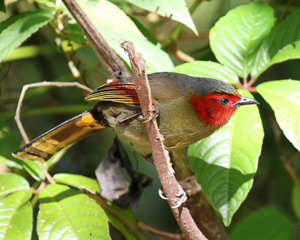
Red-faced Liocichla, one of the prime specialities of the
area, proved to be extremely hard to connect with. I spent
more than 25 hours in the field, including visiting the first
clearing on the Km21.5 Birder’s Trail about 10 times,
before finally seeing a pair there.
Trails
Bird
Watching Trips in Northern Thailand:
Birding in the north of Thailand very rewarding at most
sites of the year and usually provides exceptional views
of a high number of key species. With a variety of high
altitude forests and wetlands in the lowlands a high
number of species can be seen in a short period of time.
Contact me to arrange a birding trip and/or to discuss
the best bird watching options for you: nickupton@thaibirding.com
I made a sketch copy of Nick Dymond’s excellent map
of the area (see Introduction), which was very useful. My
computer skills are not good enough to reproduce it here!
Briefly, the main birding areas can be accessed from two points.
The trail at Km21.5 is signposted “exit from trekking
route”, easy to find from the main road.
Approximately 30 metres along here, a path heads right. It
passes some mature coniferous trees, then mixed scrub and
small patches of broadleaved forest, before arriving at a
path junction at the base of the climb to the Doi Angkhang
summit. At this point, continue straight ahead for the Summit
Trail, or turn left for the Scrub Trail. The Summit Trail
emerges on to the main road again just below the Army Camp
at Km19.9, where the path is signposted “trekking route”.
The Km21.5 trail arrives at a clearing - the famous “Liocichla
clearing” - shortly after the turn-off for the Summit
and Scrub Trails. The path then heads downhill and to the
left, passing areas of scrub and small patches of forest.
This is the Birder’s Trail. After a while it becomes
the Ridge Trail, when it joins a firebreak which follows the
crest of the ridge. The Ridge Trail climbs to a high point
before descending very steeply to a stream and small dam –
you have arrived at the far end of the Forestry Trail.
To access the Forestry Trail from the road, continue as far
as Km24. Just below the Km24 milestone, there are two roads
on the right, at almost the same point. The second road is
signposted to some villages and actually goes to the Myanmar
border. The first road descends for 100 metres or so before
passing a small guard hut (disused). After this hut there
is a junction – the left hand track goes to the Forestry
HQ bungalows. Take the right hand track and follow the path
past the hill tribe houses. Do not descend to the stream valley,
stay on the same level. This path soon enters open woodland,
then a variety of habitats including scrub, bamboo and damp
stream forest. This is the Forestry Trail, which ultimately
meets the end of the Ridge Trail at the small dam mentioned
above.
Access to the Ravine Trail is halfway along the Forestry Trail,
along a narrow path to the right if approaching from the Km24
end. As mentioned above it was seriously overgrown, and may
be easier to negotiate in the dry season.
I spent most of my time on the Birder’s Trail at Km21.5,
the Ridge Trail, and the Forestry trail at Km24. I hiked up
to the Summit once and walked the Scrub Trail twice but neither
produced any species that I did not also see elsewhere. I
also spent some time along the road mainly between Km24 and
Km20 but once as far as Km15. The best area of all was the
vicinity of the first clearing on the Km21.5 Birder’s
Trail, and the section of path between here and the bottom
of the Summit Trail steps.
Another spot which I found good was the deforested hill behind
the dam at the end of the Forestry Trail, opposite the end
of the Ridge Trail. Looking down onto the bushes and scrub
below produced my only Spot-breasted Parrotbills of the trip.
Most older trip reports mention an old orchard at Km 19.9
which used to be very productive for species like Red-tailed
Laughingthrush. An Army Camp now occupies this area. You may
not feel comfortable using your binoculars here and in any
case, most of the habitat appears to have been cut down to
make room for the camp.
Dominic Le Croissette
Birding Highlights
Mountain Bamboo Partridge
– 2 on hill behind Forestry Trail
dam, 1 on firebreak near start of Ridge Trail Speckled Piculet – 1
in bird-wave beside road at Km22 Stripe-breasted Woodpecker – common Bay Woodpecker – 2
at first clearing on Km21.5 Birder’s Trail Lesser Cuckoo – singing
male showing exceptionally well on roadside at Km20.5 Blue-bearded Bee-eater – 1,
Forestry Trail Himalayan Swiftlet – common Black Eagle – brief
eye-level views of one from top of Ridge Trail Long-tailed Shrike
– pair seen daily on Amari
resort fence at Km25 Grey Treepie – 1
from hill behind Forestry Trail dam, 2 on Scrub Trail Maroon Oriole – male
singing and showing well along Km21.5 Birder’s Trail White-gorgeted Flycatcher – 2
seen and a total of at least 4 males heard singing along first
300 metres of Km21.5 Birder’s Trail Little Pied Flycatcher –
common Hill Blue Flycatcher – one
male at campground and others heard singing Lesser Shortwing – one
showed briefly but well in dense forest close to the bottom
of the Summit Trail steps when approaching from the Km21.5
trail White-crowned Forktail – at
least 2 pairs seen on every visit to the Forestry Trail, with
recently fledged young also observed. Slaty-backed Forktail –
single seen twice near Forestry Trail dam Chestnut-vented Nuthatch – several,
Ridge and Scrub Trails
Velvet-fronted Nuthatch –
1 on Ridge Trail Yellow-cheeked Tit – 1,
Km21.5 Birder’s Trail Striated Bulbul – 1,
Km21.5 Birder’s Trail Brown-breasted Bulbul – small
numbers seen mainly along Ridge Trail but not especially common White-headed Bulbul – an
unexpected sight was a flock of 10 in trees beside the first
clearing on the Km21.5 Birder’s Trail Crested Finchbill – 3
showed very well at the far end of the Ridge Trail White-necked Laughingthrush –
flock of 4+ late one afternoon in trees near the Forestry
Trail dam plus at least one recently fledged juvenile Black-throated Laughingthrush – 1
in trees beside approach road to Forestry Trail Silver-eared Laughingthrush –
2 seen twice between Km21.5 clearing and start of Summit Trail
steps Scarlet-faced Liocichla – 2
in scrub beside first clearing on Km21.5 Birder’s Trail
at noon on the third day, as described above a very difficult
species to connect with Rusty-cheeked Scimitar-babbler – commonly
encountered on Ridge, Scrub and Summit Trails White-browed Scimitar-babbler – 2
beside road at Km 22 and 4 between the Km21.5 Birder’s
Trail and the bottom of the Summit Trail steps Spot-throated Babbler – 1,
Km21.5 Birder’s Trail Chestnut-capped Babbler – pair
feeding young close to where the Km21.5 Birder’s Trail
meets the Ridge Trail firebreak, according to Robson at a
higher altitude than normally found Yellow-eyed Babbler – 1
on hillside behind Forestry Trail dam Spectacled Barwing – single(s)
seen twice near the junction of km21.5 Birder’s Trail
and the Ridge Trail firebreak Rufous-backed Sibia
– several seen along Km21.5
Birder’s Trail, Ridge and Summit Trails Spot-breasted Parrotbill – 2
in low scrub below hillside behind Forestry Trail dam Spot-winged Grosbeak – pair
seen early one morning at the highest point of the Ridge Trail,
a real surprise.
Also of note was a singing Russet Bush Warbler
at the highest point of the Ridge Trail which is not included
in the above list as I did not manage to see it.
Other Birds Seen
Red Junglefowl
Blue-throated Barbet
Plaintive Cuckoo
Green-billed Malkoha
Greater Coucal
Mountain Imperial Pigeon
Oriental Honey-Buzzard
Shikra
Ashy Drongo
Bronzed Drongo
Lesser Racket-tailed Drongo
Ashy Woodswallow
White-throated Fantail
Grey-headed Canary Flycatcher
Verditer Flycatcher
Oriental Magpie Robin
Grey Bushchat
White-tailed Robin
Japanese Tit
Barn Swallow
Striated Swallow
If you are interested in arranging a bird
watching tour you can see some suggested itineraries here
- Birdwatching
Trips - and you can contact me at the above email address
to discuss the best options.






 Download
a full
Download
a full