Introduction Doi Chiang Dao
lies due north of Chiang Mai. From the city take route 107
north for approximately 73km, as far as the town of Chiang
Dao. There are two main birding areas here:
1) The Temple area and temple trails
- The Temple lies along a minor road, 2km beyond the well-known
tourist attraction of Chiang Dao cave. There are two ways
to get there from Chiang Dao – either turn left in the
centre of town towards the cave and “Malee’s”,
or alternatively take the almost-completed Chiang Dao by-pass
and turn left at the first major crossroads after the incomplete
section. Detailed maps and information on this area is already
available in the log book at Malee’s bungalows, and
in other trip reports, so I have not provided a map or instructions.
I spent relatively little time here, a total of one afternoon
in the Gully near the Temple, and one morning walking the
Gully and North Trails.
2) The substations area - I make no
apologies for giving very precise directions and providing
a detailed map below, as I found very little good access information
for the substation, either on the Internet or in the bird
logbook at Malee’s.
From the cave road/main road junction in central Chiang Dao,
drive back towards Chiang Mai for 5km. Look out for a green
bus shelter on the left, standing in the corner of a field
by the road. Opposite this is a concrete road with a sign
in Thai. Proceed through the village along this paved road.
The road then crosses a stream and continues through rice
paddies. 3km from the main road junction, the paved road ends.
Bear left on the unmade track as it starts ascending the mountain.
This track is rough in places although there are a few concreted
sections. It continues through forest and then passes two
small villages.
NOTE (June 2006)
["I noticed when passing along the main road past Chiang
Dao on 29th May 2006 that the "green bus shelter"
indicating the start of the road to the Den Ya Khat (DYK)
substation, which I have referred to in my site description
and map, has disappeared. The foundations of the old bus shelter
are still visible, and of course it may be rebuilt, but be
warned that at the present time it no longer exists!"]
Approximately 12km from the start of the unmade track, 15km
or so from the main road, you arrive at a checkpoint. Almost
immediately afterwards the track forks :
The RIGHT FORK goes to the Den Ya Khat (DYK) substation. The
route passes along a ridge with mature pines (the best area
for Giant Nuthatch), and then climbs up some steep hairpins
(Mrs Hume’s Pheasant in the open forest) before arriving
at the DYK substation approximately 5km from the track fork.
The LEFT FORK ends up at another substation, which I have
imaginatively entitled substation 2. To get there, continue
along the main track from the junction, remaining on the higher
trail and ignoring tracks branching off to the left and right.
Shortly before the substation, you pass an area of well-maintained
bungalows on a ridge to the right of the track (is it possible
to stay here?). 100 metres or so further along, 3km from the
track fork at the checkpoint, there is an obvious open grassy
area and group of buildings to the left. I left my motorcycle
here and continued along the track on foot for another 4km,
seeing plenty of birds including some species that are rarely
or never reported from DYK.
Many birders worry about the state of the access track and
opt to hire a 4WD vehicle and driver for the day from Malee’s.
This option was outside the scope of my budget so I had no
choice but to attempt the climb on an ordinary 125cc motorcycle.
I really needn’t have worried, as even after several
days of heavy rain the track was easily passable. It probably
wouldn’t be so easy in a 2WD car ; ground clearance
could be an issue along some of the rougher sections.
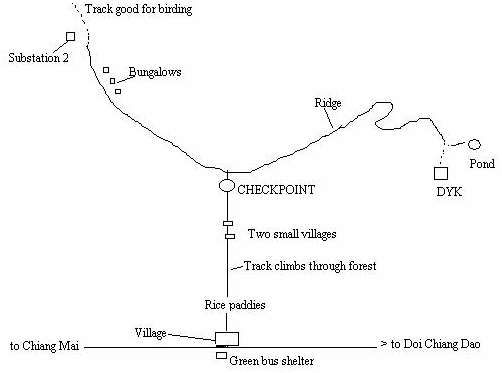
The
following rough map showing the access route to the substations
may be helpful:
3) Other information
Accommodation - I stayed at Malee’s
Bungalows, 1.5km beyond Chiang Dao cave, for 250 baht per
night for a simple room with shared bathroom. Unfortunately,
100 baht dormitory accommodation is no longer available. Excellent
food is served communally in the evenings so it’s ideal
if you’re on your own. The logbook provided plenty of
information about bird sightings but had not been updated
since March. There was also some good information in the log
about Doi Angkhang for birders proceeding to that area after
Doi Chiang Dao. Malee’s is within easy walking distance
of the Temple and its birds.
Permits - These are available from the forestry
headquarters a short distance along the road from Malee’s
to the Temple. A permit is needed to access the substations
beyond the checkpoint, and also to proceed along the road
beyond Malee’s, but is not required to visit the trails
around the Temple. The cost is 200 baht for foreigners, but
it is valid for as many days as you want (mention at the office
that you want to go to the substation and specify how many
days you would like). Despite dutifully buying my permit it
was never checked, but if the guards decide to do so at the
substations checkpoint it’s a long way to come back
and get one!
Dominic
Le Croissette
Birding Highlights
Mrs Hume’s Pheasant
– male showed superbly in the open forest between the
hairpin bends, near the DYK substation. Speckled Piculet – 1, 50m before substations
checkpoint. Stripe-breasted Woodpecker – common
beyond substation 2. Greater Yellownape – 2 on North Trail. Bay Woodpecker – 2 along track before
substation 2. Eurasian Hoopoe – 3 along DYK ridge. Blue-bearded Bee-eater – several near
the small villages along access road to substations, also
1 on North Trail. Himalayan Swiftlet – flock over road
behind Malee’s, beyond checkpoint. Crested Treeswift – 3 around temple
on two dates. Brown-backed Needletail – 5+ over DYK
ridge. Mountain Imperial Pigeon – 1 on North
Trail, 1 along substations access road, many others heard. Oriental Turtle Dove – 3 singles along
track beyond substation 2. Wedge-tailed Green Pigeon – 3+ in fruiting
tree along Gully Trail. Pin-tailed Green Pigeon – 1 with above
birds. Common Emerald Dove – common along
access road to substations in the early morning, also seen
along Gully Trail. Black Baza – 2+ along North Trail. Silver-breasted Broadbill – 1 along
track before substation 2. Orange-bellied Leafbird – 2, DYK ridge. Grey Treepie – seen in several places
along the tracks to DYK and substation 2. Slender-billed Oriole – 2, DYK ridge. Maroon Oriole – 1 along track before
substation 2, 2 along DYK ridge. Black-headed Oriole – pair frequently
seen at the start of the track to the park headquarters. Black-winged Cuckooshrike – 2 singles
along DYK ridge. Grey-chinned Minivet – 2 pairs, DYK
ridge. Asian Paradise-flycatcher – fairly
common. Large Woodshrike – several flocks along
DYK ridge. Dark-sided Flycatcher – 1, just before
DYK substation.
Little Pied Flycatcher –
2 along DYK ridge but it was very common in the pine forest
beyond substation 2. Pale Blue Flycatcher – 1 pair DYK ridge
and 1 pair beyond substation 2. Hill Blue Flycatcher
– common. White-crowned Forktail – pair and 1+
juveniles in Temple Gully, 1 near small villages along track
to the substations. Giant Nuthatch – pair with juvenile
along DYK ridge and 1 further single bird near the hairpins,
also 1 in mature pines just before the substations checkpoint. Chestnut-vented Nuthatch – almost all
sightings were beyond substation 2 where it was very common. Velvet-fronted Nuthatch – common. Striated Bulbul – 2 beyond substation
2. Crested Finchbill – 1 in scrub along
track close to substation 2, a species rarely recorded along
the DYK track. Greater Necklaced Laughingthrush –
flock of 6+ including juveniles on North Trail. Buff-breasted Babbler – common along
Gully and North Trails + nest found. Spot-throated Babbler – 1 beyond substation
2 just beyond first track junction. Rufous-fronted Babbler – common, North
Trail. Grey-throated Babbler – temple steps. Puff-throated Babbler – temple steps
and along road outside Malee’s. Pin-striped Tit-babbler – fairly common. Rusty-cheeked Scimitar-babbler – 4
in scrub close to substation 2. White-browed Scimitar-babbler – fairly
common beyond substation 2. White-browed Shrike-babbler – common. Chestnut-fronted Shrike-babbler – 1,
DYK ridge. Blue-winged Minla – several along DYK
ridge and also beyond substation 2. Silver-eared Mesia – 3 beyond substation
2. Striated Yuhina – common. Grey-headed Parrotbill – 4, DYK ridge. Black-throated Parrotbill – 2 in bird-wave
beyond substation 2, a species not previously mentioned in
the log book at Malee’s. Fire-breasted Flowerpecker – several
beyond substation 2. Thick-billed Flowerpecker – 1, North
Trail. Purple Sunbird – 1 at end of Malee’s
drive. Black-throated Sunbird – several beyond
substation 2. Ruby-cheeked Sunbird – seen several
times in temple area. Streaked Spiderhunter – several. Little Spiderhunter – regularly seen
near temple.
Other Birds Seen (Including
a brief visit to rice paddies near Chiang Dao)
Red Junglefowl
Grey-capped Pygmy Woodpecker
Blue-throated Barbet
Great Barbet
Plaintive Cuckoo
Green-billed Malkoha
Greater Coucal
Chestnut-headed Bee-eater
House Swift
Asian Barred Owlet
Spotted Dove
Crested Serpent Eagle
Shikra
Chinese Pond Heron
Blue-winged Leafbird
Common Iora
Scarlet Minivet
Bronzed Drongo
Ashy Drongo
Greater Racket-tailed Drongo
Lesser Racket-tailed Drongo
Bar-winged Flycatcher-shrike
White-throated Fantail
Grey-headed Canary Flycatcher
Black-naped Monarch
Asian Brown Flycatcher
If you are interested in arranging a bird
watching tour you can see some suggested itineraries here
- Birdwatching
Trips - and you can contact me at the above email address
to discuss the best options.
Thaibirding Merchandise
Print on demand T-shirts with original designs
featuring the Birds of Thailand available now - Thaibirding
T-Shirt Store
Central
Mongolia , 20th May-3rd June 2021 - Black-billed
Capercaillie, Oriental Plover, Henderson's Ground Jay, Azure
Tit, Pallas's Sandgrouse: Contact
me for details
Thailand
Raptor Migration, 26th Oct-5th Nov 2021 -
Black Baza, Grey-faced Buzzard, Pied Harrier, Lesser Fish
Eagle, Spoon-billed Sandpiper: Contact
me for details







 Central
Mongolia , 20th May-3rd June 2021 - Black-billed
Capercaillie, Oriental Plover, Henderson's Ground Jay, Azure
Tit, Pallas's Sandgrouse:
Central
Mongolia , 20th May-3rd June 2021 - Black-billed
Capercaillie, Oriental Plover, Henderson's Ground Jay, Azure
Tit, Pallas's Sandgrouse:  Thailand
Raptor Migration, 26th Oct-5th Nov 2021 -
Black Baza, Grey-faced Buzzard, Pied Harrier, Lesser Fish
Eagle, Spoon-billed Sandpiper:
Thailand
Raptor Migration, 26th Oct-5th Nov 2021 -
Black Baza, Grey-faced Buzzard, Pied Harrier, Lesser Fish
Eagle, Spoon-billed Sandpiper: 
 South
Korea, 5-17th January 2022 - Steller's Sea
Eagle, Relict Gull, Red-crowned Crane, White-naped Crane,
Baikal Teal, Solitary Snipe, Asian Rosy Finch:
South
Korea, 5-17th January 2022 - Steller's Sea
Eagle, Relict Gull, Red-crowned Crane, White-naped Crane,
Baikal Teal, Solitary Snipe, Asian Rosy Finch: