Introduction
Circumstances so had it that I
had to travel to a city several hours away from BKK. Having
contemplated which route to take, the possibility of taking
a "little detour" to the "much longed for"
National Park of Mae
Wong in Kampaeng Phet province, started to crystallize
in my mind. According to "the book", road signs
would be easy to follow, and all in all it would only be about
a 5 hours drive. Well, even though road signs do exist, they
are not always that easy to detect, and we found ourselves
spending at least half an hour asking the local people, including
the highway police for road 1242 towards the park. No one
were aware of the park. We later found out that the local
population relate much better to Klong Lan Park which is closer
to town and includes easy accessible waterfalls. This park
is not far from the road to Mae Wong, Mae Wong being another
20 minutes drive straight westwards. Well, we were forewarned
that we might encounter continual rains of the more temperate
type (those of you from northern Europe should know what I
am talking about) and not heavy tropical downpours. Such was
the case, as it kept drizzling until early evening.
Trip Account
We
obtained permission at headquarters to drive up the road towards
Chong Yen (Cool Passage) where the campground is located.
We
had very little time, so decided to give the area around headquarters
a miss, in spite of the possibility of seeing Crested Kingfisher.
(Apparently the bird requires one to wait for a considerable
amount of time.) We drove up the road and soon caught up with
a slow moving convoy of mountain bikers in their fancy 4 wheel-drive
vehicles going up the hill. This area truly looks like the much
talked about "hills of south-east Asia" and is very
beautiful in spite of the fact that most of the hills are denuded
and original forest long gone. Apparently, the road was built
in order to evacuate hill tribe people from the park a few years
ago and thus be able to preserve the park as a watershed for
low-lying areas. One can only imagine what it originally must
have looked like. Indeed, further up there are untouched hill
slopes, and the majesty of the tree coverage as a warm blanket
covering the slopes fills your heart with sentiments of wonder.
The campground is located at an altitude of 1360 meters and
is indeed a very windy place. It felt for a moment as if I was
back in Scandinavia on a summer's day. This is hot season in
Thailand, and to feel the temperature drop to 18°C was nice
indeed
Still undecided whether to set up tents or not (it rained continuously),
I walked around carrying an umbrella. The only bird in sight
was a brave White-throated Fantail roaming around the foliage,
so much the like its cousin, the Pied Fantail back home in Bangkok.
Well, finally the rain stopped and we set up camp. Unfortunately,
rules of behavior and conduct at these National Parks are not
always adhered to, and some very noisy individuals did their
best to keep everyone awake. (Try to avoid weekends and holidays.)
The
same noise that kept us awake greeted us to the morning. Seems
like most people got up around 5 a.m. waiting for sunrise and
going about their business. While later on around 9 o'clock,
upon leaving the area, most of the same people were still in
their tents talking away. Yes, the people are getting out of
the city and in to the parks, but now the city has to get out
of the people and the people into the woods as well!
So, at 6:30, I started my morning walk. No rain today, only
a bright sky. The road continues on from here but is closed
off to traffic, thus allowing some regeneration to take place.
However, I read that a real healthy primary forest does not
occur until the end of the road, another 15 km from campground.
I was eager to see what this area would produce as I had read
about more northern species dwelling here, including such
exciting birds as Rufous-necked Hornbill and Coral-billed
Scimitar Babbler. I didn't get to see any of these but many
other noteworthy birds.
The road for the first two kilometres from the camp ground held
patches of broadleaved, evergreen forest, grasses, bamboo and
stands of wild banana. I had hopes for more still as yet unseen
by myself, such as Long-tailed Sibia, White-browed Shrike-Babbler,
White-browed Piculet, Grey Treepie and White-necked Laughingthrushes.
It was still shady in this area as the suns rays were on the
eastern side of the mountain. I had to wait a while for some
thing to happen besides the ever-present Flavescent Bulbul.
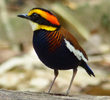
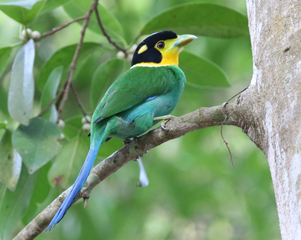
It sure paid off as a splendid Long-tailed Broadbill came in
full view. This bird looks almost like a Disney character out
of some animated movie, almost unreal. Then a splendid specimen
of a female Red-headed Trogon perching and feeding from middle
storey woodlands allowed me to have equally good looks. Things
started to pick up, and especially Babblers started to sound
off along the road side. Drongos such as Bronzed, Ashy and Lesser
Racket-tailed Drongos were easy to spot.
Coming around a bend, I heard a dry "chuk" call, followed
by a loud musical tune, which at first recalled the voice of
Black-throated Laughingthrush. However, I quickly realized that
it was a pair of White-necked Laughingthrushes, my first life
bird for the day. Then the loud sounding Grey Treepies came
by in a smaller flock, lifer number 2. A large flock of Grey-chinned
Minivets filled up the canopy while a pair of Green-billed Malkhoas
hopped around lower in the trees.
Not long after this, I had the unusual experience of viewing
both Golden-throated Barbets as well as Blue-throated
Barbets, through my binoculars, feeding in a fruiting
tree. The Golden-throated must have been a younger bird as the
golden throat hadn't developed yet, only its golden two head
patches were present. Then Yellow-cheeked Tit and Black Bulbul
flew in to confirm that I was in the more northern regions of
Thailand. Next was Crimson Sunbird feeding on a banana flower;
surprising to see this bird at this elevation. The violet head
was shimmering along with its bright red upper body as it hovered
like a Hummingbird searching for nectar. No sights of Hornbills.
This should be the beginning of breeding season, I believe,
and perhaps they are taking to other ground and habitats to
find solitude and safety.
Smaller
birds such as Bar-winged Flycatcher Shrike, Verditer Flycatcher,
Brown-cheeked Fulvettas, Chestnut-headed Bee-eater and White-tailed
Warbler filled up my time, but still I was wondering if the
Piculet would show up or not. Then a Mountain Imperial Pigeon
came real close, and I was able to get some pictures at close
range.
My projected 2 hours were now coming to an end, and I had
to quickly walk back to campground. Then suddenly a White-browed
Piculet flew in and sat still for a moment, only 5 meters
in front of me! So I got my 3rd lifer for the day, and satisfaction
filled my inner being. This was not the end though. A magnificent
example of a Maroon Oriole with a harsh and loud warning call
came close. The iris of the bird really stands out, as does
the maroon colored rump and tail. Then a pair of Stripe-breasted
Woodpeckers of the genus Dendrocopus appeared in
a tree right by and in typical woodpecker manner started drumming
away.
Back at the campground, the convoy of mountain bikers were
getting ready to take off to where I was coming from. Ideal
timing! We packed our tents, had a cup of coffee and started
on our way back down. Red Junglefowl along the roadside and
Crested Serpent Eagle soaring on high along with regularly
perching White-throated Kingfishers were all we had time to
look at. Surely it had been worth the "little detour"
we had taken, and another wonderful experience in God's glorious
garden was added to memory.
Peter
Ericsson |







 Download
a full
Download
a full