Introduction
The Western Forest Complex of Thailand is the largest area
of forest in the country, half way north between Bangkok and
Chiang Mai, and includes numerous, large national parks and
nature reserves, like Umphang Wildlife Reserve, Thung Yai
Naresuan, and Huay Kha Kaeng, home to Green Peafowl, Wild
Water Buffalo, and almost certainly Thailand’s largest
population of tiger. This is a large area of remote wilderness
and the only snag, of course, is that it is difficult to get
in. One of the best ways to get at least to the edge is at
Mae Wong National
Park.
Chong Yen campsite, at 1350m, is in an area that used to be
inhabited by hill tribes. You can still see signs of terraces
on the steep hills, but the cultivated areas are overgrown
with tall grass and scrub. There are patches of forest on
the drive up, but when you get to the ridgetop at Chong Yen,
you are rewarded with a view to the west over almost unbroken
mountain forest, and you can even walk into the forest a short
way if the trails are clear.
Directions
Chong Yen campsite is 420km from Bangkok. To get there, drive
north and, about 20km north of Nakorn Sawan, turn left toward
Lat Yao. After driving through the central market of Lat Yao
(almost another 25km), you reach a T-junction. Turn right.
Then drive just over 40km on a rather annoying road through
numerous villages until you reach a crossroads. Turn right
again (if you go straight here, you will get to a checkpoint
and a more southern section of Mae Wong NP). Go through the
next crossroads, a couple of km further on, then drive another
32km to a crossroads in a large village. Turn left; this road
leads 12km to the park entrance.
You have to buy the park entrance tickets right at the park
entrance, but tickets to camp at Chong Yen are sold separately
at the park Headquarters. The Headquarters area, including
a campsite, cafeteria, visitors centre and administrative
offices is a right turn after about another 8km past the park
entrance. If you are in a group and staying more than a day,
expect to end up with a big stack of paper slips. Once the
bureaucracy is done with, you can pass through the entrance
gate and drive the final 30km up to Chong Yen.
Timing
Thai parks are popular, a fact that is difficult to miss if
you visit any on a weekend. In the cool season (November to
February), and to a lesser extent in the dry season (February
to April), Chong Yen is packed on Saturday nights. Most of
the 4WDs snake up the road early Saturday afternoon and the
whole place turns into a sea of tents. I was once offered
a cup of whisky after getting out of my tent 6am on Sunday
morning. But the whole place is empty again by early afternoon
on the Sunday.
In the wet season, and during weekdays, the place is normally
empty. But there should still be a few cars going up the road
every day, and there is a reasonable chance you could hitch
a ride if you need one.
I’ve run into groups of Thai birders a few times at
Chong Yen, but don’t recall ever seeing a Western birder
there.
This is a lush mountain area, and you can get torrential rain
during the wet season. Sometimes it lasts all day. In the
cold season, it can get chilly at night.
Insects are a nuisance all year here. The specialty are “koon”,
small round flies with black and yellow stripes. Chong Yen
has lots, and, if it is a quiet time for other visitors, you
will find yourself to be the only banana in the supermarket.
Koon bore a small round hole into your arm or neck and can
go about their business for a while without you noticing them
at the time. But their efforts create small, bloody welts
that can later become quite itchy.
Other predators include plenty of tiny “no-see-ums”
(smaller than the koon), stripy green leeches (especially
in wet season), which would be quite attractive under other
circumstances, and, of course, mosquitos.
Equipment
The only facilities at Chong Yen are the campsite, bathrooms,
and some picnic tables. You’ll need to bring camping
gear, food and water.
A machete might be useful, because the trails are often overgrown
with briars.
Etiquette
The rangers will always appreciate you coming in to say hi.
Many are interested in birds, and/or may suggest you take
one of them along for safety reasons if you are on your own.
They once managed to fix my car very effectively after steam
started coming out of the hood half way up the mountain.
Paths
A nice, small trail starts from behind the bathrooms and travels
downhill gradually through scrub and forest passing a number
of small gullies populated by banana trees. (I will call this
“Umphang trail”, since I guess it goes in this
direction)
Another trail leaves from the left side of the rangers’
bungalows; it goes downhill more steeply through the forest
interior. I have heard these trails may join up at a waterfall,
a few km down the mountain, but I’ve never got this
far. (I will call this “forest trail”)
The last part of the access road can also be good for birds.
It is mostly through open grass and scrub, but there are a
couple of large forested gullies in the last couple of km
before Chong Yen, and the final steep section up to the campsite
is on the edge of the forest. (I will call this “access
road”).
Birds
and mammals
Most of the information is in the species list, but I will
mention a few sightings of special interest.
Burmese Yuhina – Chong Yen is one of
the few accessible spots in Thailand for this bird. It normally
inhabits even higher altitudes, but none of the roads in Thailand
go this high. One of the other spots is supposedly about 50km
before Umphang on the Mae-Sot Umphang road. It is very close
to Mae Wong as the crow flies, but is a much longer drive
from Bangkok, since you have to get there via Mae Sot and
a long windy road south of the town. I think the altitude
is slightly lower than at Chong Yen. I have only seen a pair
of Burmese Yuhina once at Chong Yen. Striated Yuhina are common
here in canopy here, and can look like Burmese Yuhina on poor
views. I hear that Burmese Yuhina are commoner at the summit
of Doi Mokoju in Mae Wong National Park, at an altitude of
nearly 2000m. This is a two-day hike in each direction, and
starts from Mae Wong HQ. It needs to be done near the end
of the wet season or in the early part of the cool season,
when the streams are full, but seems to be a popular trek
that can be organized quite routinely at this time of year
(although you might need to book the porters and guides in
advance).
Hornbills
– Chong Yen is also the best-known site in Thailand
for Rufous-necked Hornbill. Groups (sometimes quite large)
turn up sporadically at Chong Yen, but they are more regular
near the end of the wet season (normally August and September)
since I hear there are many fruiting forest lychees in the
area of the campsite. The only time I got good numbers (groups
of 15-20 flying over and perched) was during a trip in July
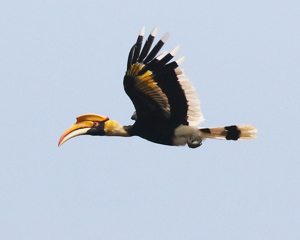
2005. There are often a couple of Great Hornbill around Chong
Yen, and I once saw three Wreathed Hornbill on the drive up.
Pittas
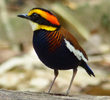
and Broadbills – There are a few calling Rusty-naped
Pitta around Chong Yen. I’ve had them maddeningly close
on a number of occasions, calling from the ground seemingly
only a few metres away, but they’ve never responded
to playback, just calling invisibly for a minutes before vanishing.
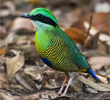
I’ve also heard Blue Pitta occasionally at Chong Yen.
Blue-winged Pitta inhabits the lower areas of the park in
the wet season, and is the only species I’ve actually
seen here. Long-tailed Broadbill is fairly common around Chong
Yen, and I’ve heard Silver-breasted Broadbill a few
times.
Pheasants
and Partridges
– Bar-backed and Rufous-throated Partridges are both
common near Chong Yen. I once saw a group of three Kalij Pheasant
in fairly unattractive-looking habitat about 10km past the
park Headquarters on the drive up. In the dry season, you
can hear Grey Peacock-Pheasant calling from the gully below
Chong Yen.
There
are millions of babblers around Chong Yen, including many
species that are scarce in the rest of Thailand. These include
White-browed, Red-billed and Coral-billed Scimitar-babblers,
White-necked, Black-throated and Silver-eared Laughingthrushes,
Long-tailed Sibia, Silver-eared Mesia, Streaked and Eyebrowed
Wren-Babblers, Grey-throated, Golden, Spot-necked and Buff-breasted
Babbler, Clicking and White-browed Shrike-Babblers, Blue-winged
Minla, Collared Babbler, Burmese, White-bellied Erpornis and
Striated Yuhina.
The Umphang
trail is good for some interesting birds that like hanging
out near small rivulets, like Rufous-browed Flycatcher, White-crowned
Forktail, White-tailed Robin, Small Niltava, and (I suppose)
the Rusty-naped Pitta.
Orange-headed
Thrush is present in the wet season. I once saw Dark-sided
Thrush a short way below Chong Yen, and have heard Green Cochoa
right at the campsite.
Large
mammals are fairly thin on the ground, but I’ve seen
a troupe of Stump-tailed Macaques immediately below Chong
Yen, a group of Red Muntjac quietly crossing the Umphang trail
(unlike Khao Yai, they don’t walk around on the lawns
here!). Phayre’s Langur can often be heard calling.
One interesting
mammal sighting I had here was of Stripe-backed Weasel. The
few previous Thai records were from north-east Thailand, but
I had one practically step on my foot after going a short
way off-trail down the “Umphang trail”. It seemed
to be attracted by my shiny, metallic minidisk player (which
I’d just put down on the ground after using –
unsuccessfully – to try to attract a nearby calling
a Rusty-naped Pitta). The weasel came up and sniffed it a
couple of times, made a noise a bit like a fairly high pitched
human sneeze, then casually wandered off.
The forest
near Headquarters is quite dry, with lots of bamboo and a
small area of dipterocarp just past headquarters. The stream
right by the Headquarters is supposed to be a good spot for
Crested Kingfisher (flying along the stream at dawn and dusk)
although I’ve never seen it.
Charles
Davies
Birds seen at Mae Wong
Chinese Pond-Heron – Around
Headquarters Striated Heron – On
the stream by Headquarters Black-shouldered Kite – Once
at Chong Yen Crested Serpent-Eagle – Fairly
common Shikra – One
a few km past Headquarters Kalij Pheasant – Once
a group of three at dusk on the road up to Chong Yen, about
10km past HQ Red Junglefowl – Quite
common, especially in the grass and scrubland, including one
sighting of an eclipse male Grey Peacock-Pheasant – Can
be heard from the gully below Chong Yen Rufous-throated Partridge – Frequently
heard and two seen around Chong Yen Bar-backed Partridge – Frequently
heard and seen several times around Chong Yen Green pigeon sp. – Sometimes
heard Mountain Imperial Pigeon – Common
around Chong Yen (sometimes abundant) Barred Cuckoo-Dove – One
seen and a few heard Emerald Dove – Sometimes
flushed from the road up to Chong Yen Vernal Hanging-Parrot – A
flyover once at Chong Yen Greater Coucal – Common
in the grass and scrub, and by the side of the road up to
Chong Yen Green-billed Malkoha – Common
in forest and scrub at all altitudes Mountain Scops-Owl – Several
around Chong Yen (e.g., final gully on the access road) Collared Scops-Owl – One
calling often from the hillside immediately above the campsite Asian Barred Owlet – Heard
once at a lower elevation Collared Owlet – Heard
most days Brown Wood-Owl – Once
heard just below Chong Yen Large-tailed Nightjar – Common
on the roads at lower elevations Indochinese Swiftlet – Groups
can sometimes be seen hawking over grassy areas in the wet
season Asian Palm-Swift – These
turn up at all elevations in the park Banded Kingfisher – Once
heard from the middle section of the road between HQ and Chong
Yen White-throated Kingfisher – Sometimes
common on the road between HQ and Chong Yen, on the road in
grassland areas, or by streams in lower areas Red-headed Trogon – Heard
once at Chong Yen Chestnut-headed Bee-eater – A
group of these sometimes appears around Chong Yen campsite Blue-bearded Bee-eater – A
pair of these were breeding in the mud bank by the side of
the road on the final ascent to Chong Yen, and could often
be seen sitting in the trees in this area Indian Roller – Common
in grassland and scrubland Rufous-necked Hornbill – Sporadic
at Chong Yen campsite, I head they are most often present
in August and September (although my only large groups were
in July 2005) Wreathed Hornbill – 3
seen flying over the road to Chong Yen (about 10km before
the campsite) Great Hornbill – One
or two often around Chong Yen Great Barbet – Common
around Chong Yen Lineated Barbet – Heard
at lower elevations Golden-throated Barbet – Abundant
around Chong Yen Blue-throated Barbet – Sometimes
heard or seen at Chong Yen Speckled Piculet – Common
(a few seen almost every visit) White-browed Piculet – Quite
common (seen most visits) Greater Flameback – A
couple seen lower down the access road Greater Yellownape – A
few around Chong Yen Lesser Yellownape – Seen
twice (once 15km before Chong Yen) Bay Woodpecker – Often
heard and sometimes seen around Chong Yen Stripe-breasted Woodpecker – Probably
the commonest woodpecker at Chong Yen Silver-breasted Broadbill – Groups
sometimes heard around Chong Yen Long-tailed Broadbill – Fairly
common (seen on about half of the visits) Rusty-naped Pitta – Seemingly
quite common, at least 4 calling birds in the gullies below
Chong Yen, but I never managed to see it Blue Pitta – One
or two heard around Chong Yen Blue-winged Pitta – Heard
and easily seen along the access road, just past headquarters Asian House-Martin – About
10 birds seen once at Chong Yen Forest Wagtail – 2
seen Grey Wagtail – Once
abundant (late July 2005) Bar-winged Flycatcher-shrike – Frequent
in mixed flocks, especially in the lower regions of the park Black-winged Cuckoo-shrike – Sometimes
in mixed flocks at Chong Yen (all my records were in the winter) Grey-chinned Minivet – Common
around Chong Yen Scarlet Minivet – Common
around Chong Yen Orange-bellied Leafbird – Common
around Chong Yen Black-crested Bulbul – Common
in the lower regions of the park Black-headed Bulbul – Seen
twice at Chong Yen Red-whiskered Bulbul – A
few seen in grassland areas Sooty-headed Bulbul – Seen
once near Headquarters Flavescent Bulbul – Abundant
in the grassland around Chong Yen, and even in small areas
of grass along the Umphang trail Olive Bulbul – Once
seen in a fruiting tree along the access road just below Chong
Yen (at about 1300m). Heard sometimes in the lower regions
of the park. Ashy Bulbul – Frequent,
a couple once seen only a short way past Headquarters Mountain Bulbul – Sometimes
abundant at Chong Yen Black Bulbul – Groups
of these sometimes turn up in the more open forest areas (e.g.,
final gullies along the access road, or open areas along the
Umphang trail) Ashy Drongo – Common
around Chong Yen Bronzed Drongo – The
most common drongo around Chong Yen and also at lower altitudes Spangled Drongo – 2
seen near Chong Yen (April 2006) Lesser Racket-tailed Drongo – Common
at Chong Yen Greater Racket-tailed Drongo – Sometimes
seen in lower regions of the park Maroon Oriole – Chong
Yen is a good site for this, and all the birds I have seen
here were males Grey Treepie – Quite
common around Chong Yen, and even in quite small patches of
forest along the upper part of the access road
Green Magpie – Often
heard and sometimes seen at lower elevations Yellow-cheeked Tit – Fairly common around Chong Yen (although not seen on every trip) Velvet-fronted Nuthatch – Fairly common around Chong Yen (although not seen on every trip) Puff-throated Babbler – Common (by voice) in the lower regions of the park Buff-breasted Babbler – Common around Chong Yen, and a few heard right down to Headquarters. White-browed Scimitar-babbler – Common around Chong Yen, seen on every visit Red-billed Scimitar-babbler – Uncommon around Chong Yen (only two groups in several visits, one flock
including White-hooded Babbler) Coral-billed Scimitar-babbler – Uncommon around Chong Yen Streaked Wren-Babbler – A few groups recorded, twice in the final gully along the access
road, once along the Umphang trail Rufous-fronted Babbler – Seen in lower areas of the park Golden Babbler – Common around Chong Yen Grey-throated Babbler – Common around Chong Yen Spot-necked Babbler – Uncommon at Chong Yen, although 5 seen on my last visit in June 2006.
One pair seemed to be nesting in the banana grove right as the access road enters Chong Yen campsite. Striped Tit-Babbler – Common at elevations Greater Necklaced Laughingthrush – A group (with Green Magpies) seen once in the lowlands, about
5 km past Headquarters White-necked Laughingthrush – Noisy groups are almost always calling around Chong Yen, probably
one of the best sites in Thailand for this bird Black-throated Laughingthrush – A few in the bushes immediately around Chong Yen campsite Chestnut-crowned Laughingthrush – Fairly common around Chong Yen, but very secretive (unlike those
at the summit of Doi Inthanon) Grey-cheeked Fulvetta – Abundant in forest around Chong Yen Brown-cheeked Fulvetta – A few heard at lower elevations in the park Striated Yuhina – Flocks in the treetops around Chong Yen on most visits Burmese Yuhina – Only one pair seen, near the top of the “Umphang Trail” in April 2006 White-bellied Yuhina – Seen once at Chong Yen Chestnut-fronted Shrike-Babbler – A few seen around Chong Yen White-fronted Shrike-Babbler – Fairly common around Chong Yen, a few seen on almost every visit Blue-winged Minla – A few seen Silver-eared Mesia – Common around Chong Yen White-hooded Babbler – One seen in the banana grove at the entrance to Chong Yen campsite
(in a flock of Red-billed Scimitar-babblers) Black-headed Sibia – A few heard around Chong Yen Long-tailed Sibia – A few groups seen along the access road to Chong Yen (especially
in the final gully) Dark-necked Tailorbird – Seen once about 10km past park Headquarters Yellow-bellied Warbler – A few seen along the lower sections of the road up to Chong Yen Radde’s Warbler – Fairly common in winter Blyth’s Leaf-Warbler – A few seen well around Chong Yen in winter, but difficult to
separate from White-tailed White-tailed Warbler – Common at Chong Yen, normally in mixed flocks with fantails, gray-headed
flycatcher etc Yellow-browed Warbler – Common in winter, especially around park Headquarters Rufescent Prinia – Common in grassy and scrubby areas along the access road, especially
at lower elevations Hill Prinia – A few in grassy areas just downhill from Chong Yen Slaty-bellied Tesia – Around small streams near Chong Yen (Umphang and forest trails) Oriental Magpie-Robin – Common in grassy and scrubby areas along the access road White-rumped Shama – Common in secondary forest at lower elevations White-tailed Robin – A few down the Umphang trail White-crowned Forktail – Commonly seen along roads and trails during the wet season Green Cochoa – Heard (April 2006) around Chong Yen campsite, and near a fruiting tree a short way down the Umphang trail Pied Bushchat – Common in grassy areas along the access road Blue Whistling-Thrush – Sometimes appears at Chong Yen (both races) Orange-headed Thrush – A pair seen in June 2006 in the final gully before Chong Yen, so presumably this species breeds in the area Dark-sided Thrush – Once seen running along the access road during a period of very heavy rain, in the penultimate gully before Chong Yen. Taiga Flycatcher – Common in winter Rufous-browed Flycatcher – A few down the Umphang trail Grey-headed Flycatcher – Abundant around Chong Yen Small Niltava – Seen almost every visit, especially down the Umphang trail Verditer Flycatcher – Often in the treetops around Chong Yen White-browed Fantail – Common around Chong Yen Black-naped Monarch – Common at lower elevations Ashy Woodswallow – Around Headquarters Brown Shrike – Common in winter in grassy areas, including at Chong Yen Hill Myna – A couple on top of a dead tree, about 5km past HQ Black-throated Sunbird – Common around Chong Yen Little Spiderhunter – A few around Chong Yen and at lower elevations Streaked Spiderhunter – Abundant around Chong Yen Buff-bellied Flowerpecker – A few around Chong Yen Thick-billed Flowerpecker – A pair once in dry forest a few km past Headquarters Chestnut-flanked White-eye – Common in winter around Chong Yen, including in the trees above the
picnic tables Oriental White-eye – Common around Chong Yen White-rumped Munia – Small groups seen a couple of times in the grassland
If you are interested in arranging a bird
watching tour you can see some suggested itineraries here
- Birdwatching
Trips - and you can contact me at nickupton@thaibirding.com
to discuss the best options.







 Download
a full
Download
a full