Bueng Boraphet is a semi-natural lake,
in Nakorn Sawan province, central Thailand, which fluctuates
in its water level throughout the seasons with the highest
levels at the end of the wet season and beginning of the dry
season getting quite low at times around April.
The lake is one of the largest single wetland sites in Thailand
and certainly one of the most famous due to the discovery,
in 1968, of the almost mythical White-eyed River Martin and
all subsequent sightings of the bird (up to 1980) which occurred
here. It is unlikely that this species will ever be seen again
but a combination of reedbeds, lotus and lilies, open water
and scrubland makes for a great birding spectacle at any time,
although the most species will be seen in the dry season.
Although this site is classified as a non-hunting area, unfortunately
this status affords the habitat itself little protection and
the reed beds are greatly reduced due to human disturbance
and the margins of the lake are under increasing pressure
from development and conversion to rice fields; whilst fishing
is allowed hunting of birds is not tolerated here.
Boat trips for birdwatching or sightseeing here are a pleasant
option for birders and non-birders alike and the crocodile
breeding centre offers a chance to see these creatures at
close quarters although with many of them having escaped in
severe flooding it is possible to find them in the lake itself!
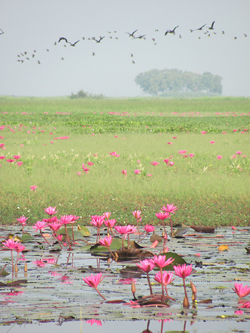
Birds aside, the beautiful array of water lilies and lotus
flowers make for a wonderful sight and great photos.
Waterbirds are obviously the main reason for birdwatchers
to visit Bueng Boraphet and the good news is that most large
waterbirds are making a comeback in Thailand, many of them
having been hunted to vitual extinction in the past. Colourful
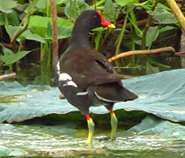
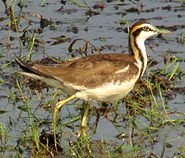
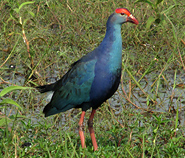
waterbirds such as Purple Swamphen, Asian Openbill Stork,
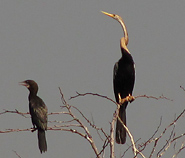
Glossy Ibis, Oriental Darter, Purple Heron, Pheasant-tailed
Jacana and Bronze-winged Jacana are the main attraction and
all of these are quite abundant. Spot-billed Pelican and Indian
Cormorant have also become increasingly common but only outside
the breeding season.
Another spectacular species is the Pied Kingfisher which can
be viewed whilst hovering before it dives to catch its prey;
whilst it is common worldwide, it remains an impressive bird.
Despite declines in recent years, good numbers of waterfowl
still use Bueng Boraphet in the winter. The resident Cotton
Pygmy Goose and Lesser Whistling Ducks are very common but
Garganey are also very numerous from December to early March.
Other species regularly found include Northern Pintail, Northern
Shoveler, Common Teal, Eurasian Wigeon, Ferruginous Duck and
Tufted Duck, although Baer's Pochard is only now seen every
few years or so in very small numbers.
Apart from large waterbirds, Bueng Boraphet is an excellent
site for other types of birds too. Asian Golden Weaver, Streaked
Weaver and Baya Weaver can all be found and this is perhaps
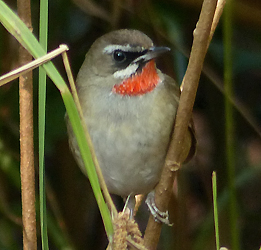
one of the easiest places to see Siberian Rubythroat. Oriental
and Black-browed Reed Warblers plus Dusky Warbler are common
in the dry season and in 2008 Thailand's first Blyth's Reed
Warbler was trapped and ringed here. Striated Grassbird, Yellow-vented
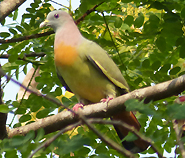
Bulbul, Pink-necked Green Pigeon, Yellow-bellied Prinia, Chestnut-capped
Babbler and Plaintive Cuckoo are all interesting birds which
are regularly seen here.
Sightings of Quail are always exciting and many species occur
here including Rain Quail, Blue-breasted Quail and Small Buttonquail,
although all are difficult to find; any grassy areas grazed
by cattle would be the best places to look for these species.
This is, of course, the only place that White-eyed River-Martin
has ever been recorded, with the last confirmed sighting in
1979 it is unlikely to ever be seen again. Read Doug Judell's
article about investigating a possible sighting in Cambodia
here: White-eyed
River Martin.
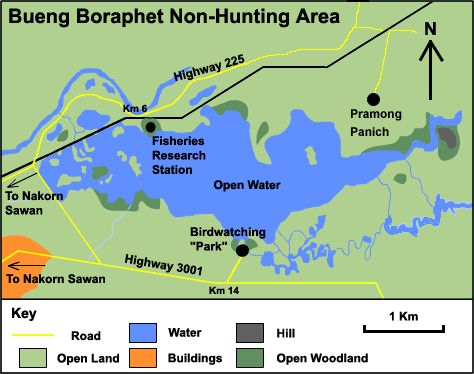
Use the interactive map below to plan your route to
Bueng Boraphet. The blue lines show the route from Nakorn
Sawan bridge (A) to the Waterbird Park (B), the Fisheries
Research Station (C) and Pramong Panich (D).
Getting to Bueng Boraphet is a relatively simple affair.
First, one must get to the town of Nakorn Sawan which is on
the main route from Bangkok to Chiang Mai (Highway 1). Nakorn
Sawan is about 3 hours from Bangkok and roughly 6 hours from
Chiang Mai and any bus doing the journey between the two cities
will stop at Nakorn Sawan bus station. For those making the
journey by bus Mor Chit Bus Station in Bangkok is the terminal
to use and the main bus station in Chiang Mai (known as Arcade)
has lots of buses heading south.
Getting from Nakorn Sawan to Bueng Boraphet by public transport
would be tricky even though it is only a few kilometres away.
For those without their own vehicle, hiring one in Nakorn
Sawan would be useful; there are tuktuks and songthaews that
could be chartered.
For those driving their own vehicle, the only difficulty is
finding the correct turn off for the lake. If heading from
Bangkok one will come to a right-hand turning about 1 kilometre
before Nakorn Sawan with the small town of Tha Tako signposted
in English. Take this road (highway 3001) and continue for
14 kilometres until seeing the sign for Bueng Boraphet Waterbird
Park ("Nok Nam Park") where there is a small statue
of a pair of White-eyed River Martins on the left. Take this
road that heads north, for 3 kilometres until reaching the
Waterbird Park.
For those wishing to head to the Fisheries Research Station,
on the north side of the lake, there is another right-hand
turning (if one is heading north) onto highway 225 shortly
before the bridge over the river and the city of Nakorn Sawan;
this road heads to the town of Chum Saeng which is signposted
from the main highway 1. Continue for 6 kilometres before
seeing a right hand turning for Bueng Boraphet lake.
Both of the highways heading to the lake are on the south
side of the bridge that crosses the large river with Nakorn
Sawan city on its northern bank.
Bird
Watching Trips:
If you need help organizing a bird watching trip to Thailand,
take a look at the suggested itineraries for ideas on
creating a tailor-made trip and contact me for advice:
Thailand
bird tours.
Finding Birds
Waterbirds can be found throughout the lake and open-country
species are fairly even distributed around the site. However,
successful birding at Bueng Boraphet is mostly a question
of finding where the best access is.
There are three main places where the lake and fringing habitats
can easily be accessed; the Fisheries Research Station, the
"Birdwatching Park" which is widely signposted in
English as "Nok Nam Park" and "Pramong Panich".
In order to watch most of the waterbird species it is necessary
to hire a boat and at both the above locations this is possible
although the staff at the "Birdwatching Park" are
knowledgeable about the species birders want to see and used
to catering for birders and photographers.
Siberian Rubythroat is abundant and can be teased out of the
undergrowth in the early morning and late afternoon at almost
any location around the lake between mid November and mid
March.
Asian Golden Weavers can easily be watched at the crocodile
pens at the fisheries research station during the breeding
season (March to July).
Ducks usually arrive in early December and can most often
be found in the shallows on the north side of the lake - you
will need a boat to observe them.
Waterbird
Park ("Nok Nam Park") : This area
gives birders one of the best opportunities to find a wide
variety of species including passerines in the reedy and scrubby
areas as well as waterbirds from the lakeside and boat.
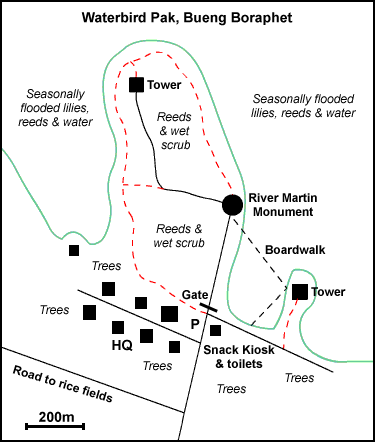
Bird watchers should park in the designated area (marked "P"
on the map) and investigate from there. The road which goes
towards the River Martin Monument has a locked gate across
it barring access, although if you are disabled then find
someone official looking and they will probably help you gain
access by vehicle.
Snacks and simple meals can be found at the kiosks near the
toilets and ask here for boat trips on the lake; Mr Phanom
has been providing this service to birders and photographers
for years and is very sharp-eyed and knows where the birds
are at any time of the year. He charges 500 baht per hour
for trips on a flat-bottomed boat with seating and a canopy
for shade.
In the mornings there can be a fair amount of activity around
the car park. Mostly these will be common birds such as Asian
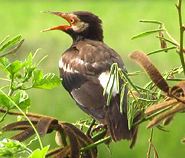
Koel, Asian Pied Starlings, Mynas and Oriental Magpie Robin
but Lineated Barbet and Brown-throated Sunbird are often here
and Black-naped Orioles are usually obvious in the dry season.
A couple of Eastern Jungle Crows specialize in stealing your
food in this spot if you leave it unattended!
The nature trail (Marked as red-dotted line on the map) takes
birders through some good habitat with small trees, reeds,
wet scrub and patches of grass. Green and Blue-tailed Bee-eaters
can usually be found and Baya Weavers nest here in small numbers.
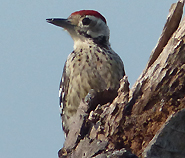
This is also a good area to find Freckle-breasted Woodpecker
and Spotted Owlet in the trees here and around the headquarters.
Other resident birds to look out for are Pink-necked Green
Pigeon, Yellow-bellied Prinia and Yellow-vented Bulbul.
Migrant birds love these wet, messy areas and as birders walk
along the trail lots of "tick', "tuck" and
"ttttttt" sound will be heard. These belong the
skulking species such as Black-browed Reed Warbler, Thick-billed
Warbler, Oriental Reed Warbler, Dusky Warbler and Siberian
Rubythroat all of which are very common here. Much rarer species
(Blyth's Reed Warbler and Large-billed Reed Warbler) have
also been mist-netted here but identifying these birds in
the field is not really likely here.
Migrant Starlings are also likely to be found here with White-shouldered
and Chestnut-tailed being the most frequently seen; they are
easiest to spot when they gather in the late afternoon before
going off to roost.
In the dry season I have seen several species of flycatcher
in this area with Taiga and Asian Brown Flycatchers being
the most common, and this spot would be worth investigating
during migratory periods for all manner of passage migrants
that are likely to show up.
A couple of bird watching towers in this zone allow birders
to get up high but they are a bit too far away from the action
to be of much use. A telescope gives decent views of birds
out on the lake but a boat trip is much better for getting
close-up views.
Surrounding the "waterbird park" is the lake. For
most of the year the water is mostly covered by lilies, lotus,
reeds and Typha but at the end of the wet season
there will be a lot of open water. These areas are some of
the richest wetland habitats and are home to a multitude of
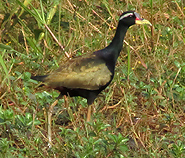
birds. Purple Swamphen, Purple Heron, Oriental Darter, Pheasant-tailed
Jacana, Bronze-winged Jacana, Cotton Pygmy Goose and other
wildfowl can be found either from the trail, the boardwalk
or a boat trip gives the best views. Striated Grassbird can
often be spotted singing from clumps of vegetation in these
areas.
In 2014 large scale works were
carried out in the "waterbird park" area which
have resulted in widespread devastation in order to
create sterile, manicured habitats which the staff seem
to think will attract birds. A total lack of understanding
of wetland ecology and habitat destruction by the authorities
in charge of this area makes its status as a Ramsar
site ridiculous and the statement on the Ramsar
website that there is a sustainable management plan
is laughable.
Since works have finished no-doubt some of the habitat
will become overgrown and attractive to birds, but much
of the area has been "cleaned up" and looks
like it will remain in a manicured condition.
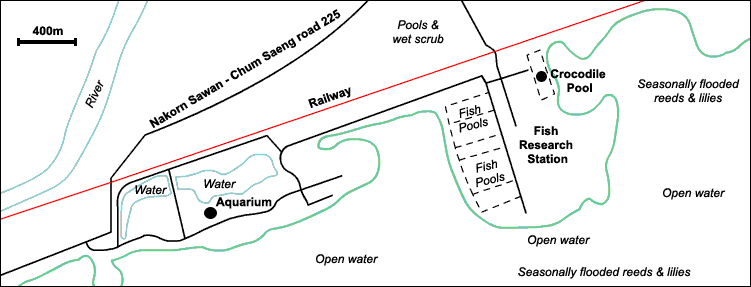
Fisheries
Research Station : The habitat in this
area is not as good as it once was due to development and
the building of flood barriers in 2012, however, a number
of the commoner birds can still be found as well as a few
scarcer species and it can still be worth a few hours here
in the late afternoon. A number of access tracks between research
buildings and pools provide access to small patches of grassland,
parkland and lake edge and a fair number of birds can usually
be seen around here.
This location provides easy birding and a large
number of species without expending very much
energy at all and makes a nice link between the
central and northern legs of your birding trip.
Contact me to arrange a birding trip and/or to
discuss the best bird watching options for you:
nickupton@thaibirding.com
The vicinity of the aquarium does not have a whole lot to
interest birders, just common species such as Mynas, although
one can get to the lake edge here and view birds out in reedy
areas through a telescope.
Towards the Fish Research Station there are some experimental
fish pools with unkempt edges that play host to a few species
including Yellow-bellied Prinia, White-throated Kingfisher
and hovering Pied Kingfishers. Other common species here include
Green Bee-eater, Blue-tailed Bee-eater and Ashy Woodswallow.
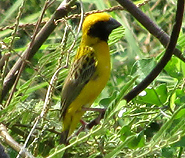
In the crocodile compound a small colony of Asian Golden Weavers
breed from March to July and in this protected area the birds
can be quite confiding with some nests close to the walkway.
A paved track goes around the crocodile pool and walking around
here can turn up some interesting resident species including
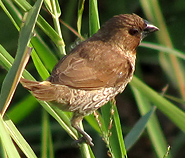
Yellow-eyed and Chestnut-capped Babblers, Chestnut Munia and
Yellow-vented Bulbul in the low vegetation while in the trees
Freckle-breasted Woodpecker and Pink-necked Green Pigeon are
regular.
Some migratory species can usually be found around here between
the months of November to April. Eastern Stonechat, Brown
Shrike and Chinese Pond Heron are easily seen but Dusky Warbler,
Siberian Rubythroat and Black-browed Reed Warbler require
rather more effort. From the lakeside next to the crocodile
pond it is often possible to spot a hovering Pied Kingfisher,
resting Oriental Darters and many other waterbirds such as
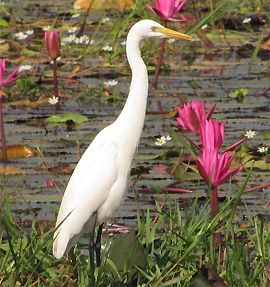
Purple Heron, Eastern Great Egret and others. Large numbers
of birds pass through here in the evenings on their way to
roost.
An access road goes right into the research centre and it
takes birders up to the lake's edge. From here flat-bottomed
boats can be hired for getting close to the birds that occupy
the reeds and lillies that can be seen from the lake side.
Alternatively birds can be viewed from some distance using
a telescope.
Pramong
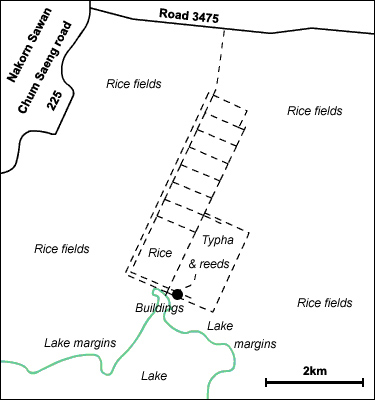
Panich : This large area of disused fishponds
and rice fields is accessible from the road 3475 and is a
great place to see many wetland and open country species including
some of the scarcer species and it is worth spending a morning
or late afternoon here. Many of the commoner species can readily
be seen here by driving along the network of dirt tracks and
this makes it a good spot for photography as the vehicle can
be used as a mobile hide. While the vaulable rough habitat
in this area keeps getting converted into sterile "experimental
rice plots" it is still, for the time being, high in
bird abundance.
The dirt track accessing this area is well-made and can be
negotiated by most vehicles and as birders drive along it
many open-country species can be seen, perhaps most notably
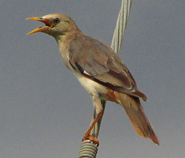
Chestnut-tailed Starling which can be found on the wires and
low bushes. The rice fields alongside the access track usually
contain Pheasant-tailed Jacanas, Asian Openbill and sometimes
Glossy Ibis; it is also a good area to look for Greater Painted
Snipe.
During the wet season nesting colonies of Baya Weavers can
be found in the trees throughout this area and small colonies
of Streaked and Asian Golden Weavers are easily found in the
low, waterside vegetation, in fact all three species are surprisingly
abundant. This area is also the best place to look for one
of Thailand's rarest breeding birds - Pied Cuckoo - which
is an annual, wet season, visitor to this spot in small numbers.
In the dry season a good number of skulking species can be
located in this area, such as it is covered in low, scrubby
bushes and wet patches. Siberian Rubythroat is quite common
in this area but can be difficult to tease out although Dusky
Warbler is easier due to its abundance. For those wishing
to look for Pallas's Grasshopper Warbler and Lanceolated Warbler
this would be a good place to visit.
Stopping the vehicle at the buildings marked on the map will
allow birders to get out and walk around in an area of Typha
and reeds as well as other vegetation among patches of farmland.
Plain-backed and House Sparrows will be seen around the buildings
themselves and one can usually get good views of Straited
Grassbird, Blue-tailed Bee-eater, Plaintive Cuckoo and Yellow-vented
Bulbul; the dry areas here are worth a look for Savanna Nightjar
which often calls from wires just before dark.
In the late afternoon birds become very active around this
location and photographers are well advised to find areas
where birds are bathing in order to get nice shots of mynas
and starlings.
There is also access to the lakeside here and it is a good
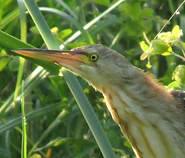
spot to wait for Yellow and Cinnamon Bitterns to emerge and
give flight views and the margins here might provide sightings
of crakes and rails when the water levels are right. The water
is too far away to be able to see anything of any winter ducks
other than them flying around in flocks in the distance so
it is best to concentrate on the birds that can be found on
the overgrown pools and rice fields.
Open
Water : Bueng Boraphet is a very large
lake and hiring a boat is essential if wishing to find wildfowl.
Numbers of ducks have decreased over the last few decades
and only the commonest species are regular visitors, although
rarer species do turn up in very small numbers almost annually.
Lesser Whistling Duck and Cotton Pygmy Goose are both very
common residents here and these are easily seen at any time
of the year. Of the migratory ducks Garganey are still very
abundant and the large flocks they occur in can be quite spectacular.
Northern Pintail are also regular visitors with species such
as Northern Shoveler, Common Teal and Eurasian Wigeon often
present in small numbers. Ferruginous Duck are still seen
in most years along with occasional Tufted Duck.
The lake still does produce rarer species of wildfowl and
Baer's Pochard was seen here in 2009 and 2010 but not since
then. Ruddy Shelduck makes an appearance every now and then
in small flocks and there have been single records of Comb
Duck and Greater Scaup in recent years too but visitors should
not expect to see lots of species of ducks but keep in mid
that there is always the chance of something rare in the right
months.
Little Grebe forms huge rafts of birds in the dry season but
the rarer Black-necked Grebe has occurred as has Great Crested
Grebe.
In the wet season Spot-billed Pelicans often occupy the lake
and birders can get quite close to them in a boat. Over recent
years quite a flock of Glossy Ibis has built up at this site
and they can frequently be seen flying across the water to
their feeding grounds.
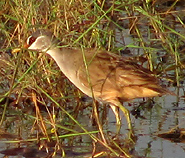
As one glides around the lake in a boat huge numbers of waterbirds
form and amazing spectacle with large numbers of Egrets, Herons,
Grey-headed Swamphens, Jacanas, Pond Herons, Cormorants and
Openbill Storks.
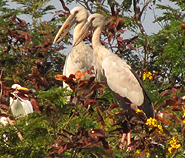
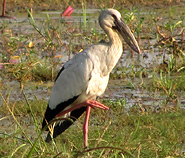
Asian Openbills:
It is worth mentioning the huge colony of Asian Openbills
that have built up at Bueng Boraphet. These storks continue
to become increasingly common in Thailand, feeding on a large,
introduced snail which is a pest to rice crops. Sometimes
visitors will see huge numbers of these birds and other times
only a few if they are feeding away from the lake. If visitors
scan the horizon in the heat of the day, thousands of storks
can often be seen soaring on thermals.
Facilities
The town of Nakorn Sawan is close enough to Bueng Boraphet
for it to be the natural choice to stay. There are plenty
of hotels to choose from with the Asia
Nakorn Sawan offering clean air-conditioned rooms
from 800 baht per night including a decent Thai-style buffet
breakfast. In Nakorn Sawan any service/convenience that could
conceivably be required is available; banks, laundry, supermarkets,
hospitals, restaurants, bars can all be easily found.
Boat trips can be arranged from both the "bird watching
park" and the fisheries research station, although it
is best to head to the bird watching park area and ask for
Khun Phanom who knows the birds of the lake very well. There
has been a lot of disturbance and damage at the fisheries
research station and toilets are rather rudimentary. However,
at the birdwatching park simple food (lunch only) and fairly
clean toilets are available as well as cold drinks.
For birders who want an early start it is probably best to
buy food from one of the large supermarkets in Nakorn Sawan
the day before and take it out to eat while birding.
Books I Recommend
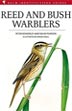
Reed
and Bush Warblers If you want to get to grips with this extremely
difficult and skulking group of birds then you need
this book. This is one of the very best ornithological
books with extended accounts on each species, superb
plates and a wealth of photographs. One of my favourite
books.
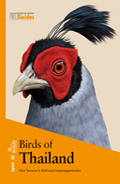
Birds
of Thailand This field guide has set new standards in identifying
birds in the wild in Thailand. With the most up-to-date
taxonomy of any publication this is the book you need
if you are birdwatching in Thailand. Forget all of the
older guides and buy this one.
Bird
Watching Trips:
Bueng Boraphet is a good site to add to
your bird watching itinerary for a large number of species
and great photo opportunities. Some uncommon species can
be found here and maybe a few surprises.
I
Hope You Enjoyed This Page
If you found the information you were looking
for here please let others know by liking this page on
Facebook and Tweeting it.














 Download
a full
Download
a full