Khok Kham is an area of salt farms
and fish ponds in Samut Sakhon province, close to Bangkok,
in Central Thailand and at first glance this rather barren
and suburban area seems a fairly unlikely place to go bird
watching; this is definitely not one of the most scenic parts
of the country. However, large numbers of shorebirds, egrets
and terns congregate here in the winter months (October to
mid-April) with many exciting species seen regularly and this
is an ideal place to go as a half day trip from Bangkok. Indeed,
visiting this site is a good option for those birders who
have limited time and want to search for the critically endangered
Spoon-billed Sandpiper.
This site is completely open with very little vegetation,
apart from some mangrove fragments, and certainly no shade
to speak of so it is a good idea to go armed with sunscreen
and a hat; some people bring along a parasol! At Khok Kham
the birds can be quite approachable if you exercise good field
craft but here a telescope is more or less essential to search
through the flocks of birds.
A number of dirt tracks allow birders to get access to various
parts of the site but most people begin their search at the
Khok Kham Birds Centre car park which adjoins one of the better
patches of salt farms which are sadly in decline here. The
main shorebird site is of prime interest to keen birders but
of little interest to others. For those travelling with a
non-birding partner the nearby "Red Bridge" is a
pleasant place to visit and a great spot for photographing
gulls and terns with some good seafood restaurants for lunch.
Shorebirds are the main attraction here, indeed, they are
almost the only birds one is likely to see here due to a severe
lack of vegetation but with a supply of shallow water and
mud there is usually a plentiful supply of wading birds. The
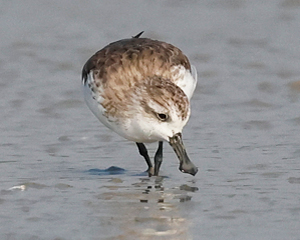
most exciting species to look for at Khok Kham is, of course,
the critically endangered Spoon-billed Sandpiper which is
seen every year from about late October to the first few days
of April, but which numbers no more than two or three birds
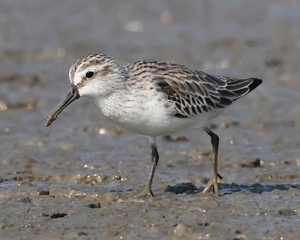
at this site, feeding alongside other small shorebirds such
as Red-necked Stint and Broad-billed Sandpiper.
This highly sought-after species is by no means the only attraction
however, as every year there are species such as Great Knot,
Nordmann's Greenshank, Asian Dowitcher and Long-toed Stint
to search for. Other rarer species that can show up include
Sharp-tailed Sandpiper and Red-necked Phalarope. A good number
of Terns frequent this site too with CaspianTern and Gull-billed
Tern are both commonly seen here, although Little Tern and
Whiskered Tern are usually the commonest species. Although
the number of salt pans here has decreased over recent years
this is still a good place to see a large number and good
variety of Thailand's wading birds and is often the easiest
sitein Thailand to get good views of Spoon-billed Sandpiper.
Use the interactive map below to plan your route to
Khok Kham. The blue line shows the route from Sathorn Road
(A) in downtown Bangkok to Khok Kham (B).
By Car/Motorcycle
Khok Kham is a very convenient place to go birdwatching if
you are staying in Bangkok and you do not time to go further
afield. If driving, simply get on Rama 2 Road which is the
main road towards the south and head for Samut Sakorn. In
the early morning this is quite a quick journey, taking around
an hour from Bangkok. However, later in the day the traffic
can get quite bad and the journey to Samut Sakorn can take
much longer. If you miss the turn off indicated on the map
then you can just continue along Rama 2 Road and take an alternative
route from the town of Samut Sakorn itself. Using Google maps
or suchlike is the best way to navigate here as the road systems
can be a bit confusing, not least because there seems to be
constant roadworks at some point along the journey.
Having
found your way there birders need to be on the south side
of the large canal along which the road runs, once you have
located a bridge, drive across and bird along the parallel
road. The dirt tracks here are pretty solid and a hire car
can be driven along some of them with no concern, although
locals may not appreciate you driving along tracks if you
block access. On a good day some of the side tracks can be
negotiated too, but after rain these side tracks turn into
mud glue.
By Bus
It is possible to get to Samut Sakorn by public transport;
there are plenty of buses from the Southern bus terminal but
the distance from Bangkok city centre to the bus terminal
is such that it turns a short journey into a long one. If
you do find yourself at Samut Sakorn bus station then some
sort of transport will be needed from there. You might be
able to get a motorcycle taxi or some other form of transport
to get you to the salt farms. If you do decide to travel by
bus it would be better to find a way of contacting Mr Tii
in advance and ask him to collect you.
By Taxi
Hiring a taxi for the duration of your visit, from your hotel
in Bangkok, would be the best option for birders without their
own vehicles. Alternatively it would also work to take a taxi
to the salt pans and pay the driver, allowing them to leave,
and then use the Grab
App to summon a ride back into town.
By Tuk Tuk or Motorcycle Taxi
It is far too far from Bangkok to Khok Kham using these modes
of transport, you are more likely to end up having an accident
than ever reaching your destination.
By Train
Mahachai (Samut Sakorn) has a station that can be reached
from Thonburi station (Take the BTS to Wong Wian Yai) in Bangkok,
the time table and details can be seen here: Travel
from Thonburi to Mahachai. From here you would have to
hire some local transport to get to the mangrove centre.
By Plane
The nearest airports are Don Muang and Suvarnabhumi in Bangkok.
From both of these locations there is self-drive car hire
and taxis.
Bird
Watching Trips:
If you need help organizing a bird watching trip to Thailand,
take a look at the suggested itineraries for ideas on
creating a tailor-made trip and contact me for advice:
Thailand
bird tours.
Finding Birds
For those looking for shorebirds the best plan is just
to locate the areas of salt farms and start scanning through
the flocks. The area of salt pans here is not that large any
more so there are often good numbers of birds within them.
Salt
Farms: Finding the salt farms is the key to
locating Spoon-billed Sandpiper and many other species of
shorebirds. Salt farms consist of a series of small, square,
shallow pools and they are easy enough to spot even if you
have never seen one before. Sometimes, on arrival at Khok
Kham, it can appear disappointing, with very few birds obvious.
The birds here move around the site, following the water levels
that suit them most. Typically they seek out ponds that are
in the process of being drained and have a shallow layer of
water still in them and/or ponds that have small puddles with
soft mud.
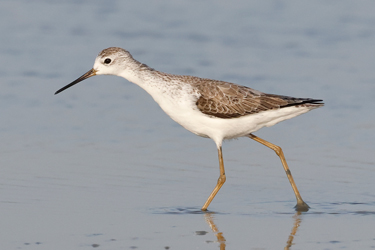
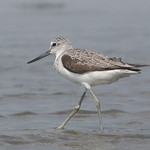
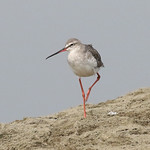
Once the congregations of shorebirds has been located species
such as Spotted Redshank, Broad-billed Sandpiper, Curlew Sandpiper,
Marsh Sandpiper and Kentish Plover are usually common.
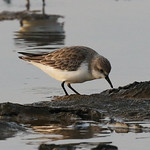
Spoon-billed Sandpiper is a tiny bird and usually likes to
feed on the edge of very shallow water or muddy patches alongside
Red-necked Stint. Its bill shape is not always obvious until
it is seen face on so close scrutiny of all the stint-sized
birds is advised. Commoner birds likely to be seen while searching
include Whiskered Tern, Greater Sand Plover, Tibetan Sand
Plover, Temminck's Stint and Long-toed Stint. Some of the
rarer birds that also show up here are Great Knot and Nordmann's
Greenshank. These birds are usually present but in smaller
numbers than some other sites.
Mangrove
Centre: A small mangrove research centre gives
access to some of the commonest mangrove species such as Collared
Kingfisher, Pied Fantail and Golden-bellied Gerygone. This
latter species can usually be heard before it is seen and
is common even in mangrove fragments.During migratory periods
these mangrove fragments can be interesting in turning up
species like Yellow-rumped Flycatcher or Eastern Crowned Warbler.
The
Red Bridge & Seafood Restaurants: This
area has become something of a local tourist attraction for
the sea views and a stroll on the boardwalk known as the "red
bridge". This has resulted in a mini industry of vendors
selling food to feed to the ever-increasing number of gulls
that loaf around here.
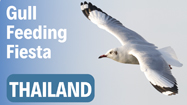
A flock of up to a thousand Brown-headed Gulls are present
between the end of October and mid-April and noisily scramble
for food thrown to them by visitors; occasionally other species
of gull can join the flock and I once got lucky with a Christmas
Island Frigatebird attacking the gulls here too. Whiskered
Terns are usually numerous here as well making this an excellent
spot for flight shots of these as well as the gulls.
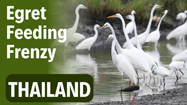
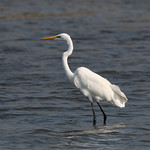
Great Egrets, Little Egrets and mangrove-loving Little Heron
can usually be found here too with Little Cormorants also
being obvious. The mangrove fragments hold plenty of Collared
Kingfishers, which are most easily seen at low tide and/or
in the early morning, as well as the tiny Golden-bellied Gerygone
which is usually quite vocal. When mud is exposed this can
be a good spot to see Asian Dowitcher, particularly in March
and April, and at that time of the year Grey-tailed Tattler
on passage migration is always a possibility too.
Khok Kham shorebird site has very few facilities right
on site to speak of, although there is apublic toilet in the
Bird Centre building, so it is a good idea to bring plenty
of water to deal with the heat in this exposed location. As
one travels to the site plenty of convenience 7-Eleven convenience
stores will be passed where birders can buy supplies for the
morning. There are also some very small local shops along
the road which runs adjacent to the salt farms and locals
will always be happy to see foreign customers buying water
and/or snacks.
Mr Tii is a friendly chap and is often in the area; he can
help you find Spoon-billed Sandpiper for a fee. For those
who are particularly averse to setting foot in Bangkok,
where there are an infinite number of hotels, there is a very
pleasant looking accommodation right at the Red Bridge; Chan
Le Resort which would put birders in a good location
for birding in the morning. The nearby provincial capital
of Samut Sakhon has all the facilities of a large town, supermarkets,
hospitals, banks etc. should they be required. Here, The
Eight is a good value-for-money and pleasant
hotel.
Along the road back to Samut Sakorn are a wide variety of
restaurants where lots of delicious dishes are available at
a very reasonable cost.
This location is not a National Park and you will not be charged
to go birding here.
Some Useful Books
Shorebirds:
An Identification Guide to the Waders of the World This is still the most complete guide to shorebirds
with a wide variety of plumages of all species illustrated
both standing and in flight. Packed full of information
this is the book if you want to learn more about this
group of birds.
Waders
of Europe, Asia & North America With beautiful and bright illustrations this is
a true field guide to this group of species that easily
is easily carried while traveling. Not as much information
on the ecology of the birds covered in this book but
much more portable than any other while covering all
aspects of identification.
Bird
Watching Trips:
Khok Kham is a good site for a half-day
of birding and makes a convenient location for a quick
"twitch" for Spoon-billed Sandpiper and there
is always the chance of a Thai rarity here.
I
Hope You Enjoyed This Page
If you found the information you were looking for here
please let others know by liking this page on Facebook
and Tweeting it.







 Shorebirds:
An Identification Guide to the Waders of the World
Shorebirds:
An Identification Guide to the Waders of the World







 Download
a full
Download
a full