Muang
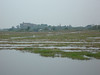
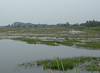
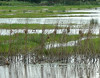
Boran Fishponds, in Samut Prakarn
province, consists of a patchwork of shallow fish ponds
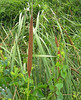
and drainage ditches of varying size, with areas of typha,
reeds, open water, hedgerows and lilies. The area is completely
surrounded by industry and housing but it is a really
good place to visit whilst staying in Bangkok, a taxi
will only take about 30-40 minutes from the city centre
early in the morning, ideal for a half day of birding.
The best time to visit this location is between November
and April, when there are large numbers of migrant birds
present as well as fine weather, and sixty to eighty species
are easily seen in just a four to five hour visit. However,
bird watching at Muang Boran Fishponds between the months
of May and October will still provide views of lots of
interesting species and this is the time to see breeding
birds, most notably the weavers, Pheasant-tailed Jacana
and Javan Pond Heron, at their most colourful, when they
can be seen in their colourful breeding plumages.
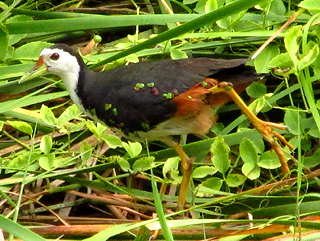
White-breasted
Waterhen
(Photo by Nick Upton)
This area is state owned and farmed by a number of families
who don't seem to mind people walking around to see birds,
but please remember to be polite and keep out of some areas
if asked. People here are quite poor and some trap and shoot
birds to supplement their income (Persecution
of birds) or to protect their fish stocks (Dead
Birds at Muang Boran Fishponds) and there is
also a problem with dumping
of industrial waste. These activities are upsetting
but I would suggest not removing hooks or lines yourself;
it is best to take a photo and report them to the Bird Conservation
Society of Thailand; bcst@bcst.or.th.
Birding Highlights
Waterbirds
and open-country birds are the main reason for a visit
to this venue. As well as numerous Egrets, Herons, Bitterns,
Cormorants and Jacanas, the Crakes/Rails and Reed Warblers
are particularly well represented here.
Striated Grassbird is probably more numerous here than
anywhere else that I've visited in Thailand, and it is
easily seen all year round uttering its noisy call for
much of the year. The sheer number of Acrocephalus
warblers allows good views of many species and the separation
of Black-browed from Manchurian Reed Warbler. Oriental
Reed Warbler is very numerous in the dry season and Thick-billed
Warbler can sometimes be found. Rusty-rumped (Pallas's
Grasshopper) Warbler is occasionally seen here with Blunt-winged
Warbler being available for those willing to spend time
checking out all the" small brown jobs".
White-breasted Waterhen, Common Moorhen and Ruddy-breasted
Crake are very numerous and both White-browed Crake and
Slaty-breasted Rail are commonly seen here. In addition,
Watercock can be found throughout the year and Baillon's
Crake puts in an appearance in the winter months; Bronze-winged
and Pheasant-tailed
Jacanas are common throughout the year.
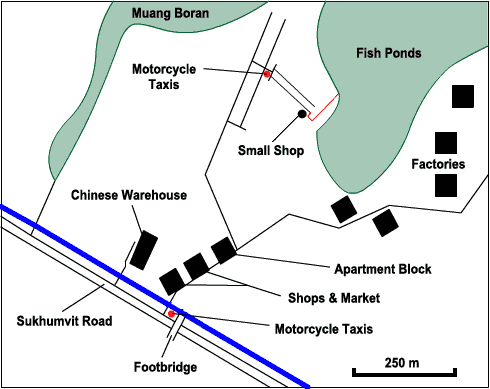
Use the interactive map below to plan your route to
Muang Boran Fish Ponds.
Getting to this site can be a little tricky. The first
step is to make the journey to Muang Boran (Ancient City)
which is a little-visited tourist attraction with recreations
of cultural landmarks from around the country. Muang Boran
can be found in most guidebooks that deal with Thailand and/or
Bangkok. The easiest way to get to Muang Boran is to take
a taxi from central Bangkok; virtually all taxi drivers know
the site; the fare will be somewhere between 250-350 baht.
To make sure you do not have any trouble communicating with
the taxi driver I have prepared Muang
Boran in Thai script for you to print and show
drivers so that you can make sure they know where to take
you; remember to check that the driver switches on the meter
of the taxi.
I would not suggest trying to get here by bus or songtaew
as, although it is possible, the chances of a visitor who
cannot speak Thai getting lost are extremely high and it would
take a very long time on slow local transport; finding the
right bus to get you here would be next to impossible.
From Muang Boran to the fishponds is no great distance, but
having to make a short journey through some residential areas
has the potential for difficulties so I shall describe the
route with the aid of the simple sketch map below.
It
is necessary to take a motorcycle taxi from next to the
footbridge and follow the route to the other motorcycle
taxi stop marked in red on the map. The tricky bit here
is to turn left immediately after the apartment block
and not turning into the apartment car park itself. From
the second motorcycle stop it is easiest to walk; simply
walk along the road past a couple of small shops where
it is a good idea to buy water if you do not already have
enough. Foreigners walking through here are a source of
entertainment, so be prepared to be stared at. At the
end of the road is a small walkway in order to cross a
ditch heading towards some wooden shacks. Turn left here
and you are into the fishponds; congratulations!
Although this sounds difficult in reality all the tracks
quickly turn into dead ends if you go the wrong way, so
if you do not get it right first time a little perseverance
will get you to the right place.
Plenty
of people have e-mailed me telling me that they successfully
followed these directions! If you try to follow them and get
lost let me know where the directions became hard to follow
and I will try and improve them.
Bird
Watching Trips:
If you need help organizing a bird watching trip to Thailand,
take a look at the suggested itineraries for ideas on
creating a tailor-made trip and contact me for advice:
Thailand
bird tours.
Finding Birds
Finding birds at Muang Boran Fish Ponds is fairly easy
due to the open nature of the site, although some of the Warblers
can take some time to see due to their skulking nature. Waterbirds
are common throughout the site and it is possible to see almost
all the Thai Egret/Heron/Bittern species here in a day. Over
100 species have been recorded here, and a 3-4 hour visit
between the months of October to April will typically reveal
around 70 species.
Striated Grassbirds can be seen throughout the site; adults
favour exposed perches to call from, or can be seen as they
fly up out of reedy areas to call.
Indian Cormorants are numerous here, being easy to see perching
on the few large trees around the extremities of this site.
When perched, they are easily separated from Little Cormorants
by their size and bill shape, when in flight separation of
the species is not so simple, but possible; Little Cormorants
have rapid wingbeats whereas the Indian Cormorant has a somewhat
less panicky flight pattern.
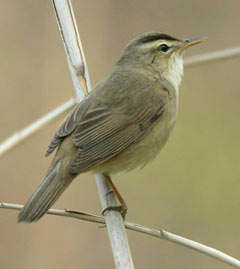
A number of species of Acrocephalus warblers can
be found around the site; Black-browed Reed Warbler is common
and easily observed, but it is worth spending some time examining
these, for Manchurian Reed Warbler is often present and is
separated by its longer, stouter bill and thinner black eyebrow.
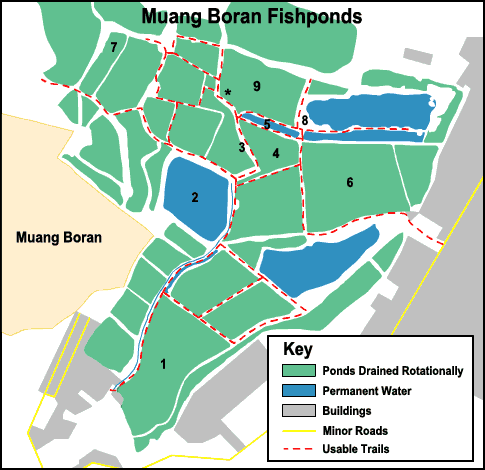
Pond
1: This is the first pond one sees
on entering the site and it is worth spending at least
half an hour watching birds here. Its shallow nature means
it is good for Pond Herons, Jacanas and Egrets. This is
also where large groups of Whiskered and White-winged
Tern congregate and both can bee seen fishing here.
Another bird which can usually be seen in this vicinity
is Striated Grassbird, with one bird favouring a dead
tree to the left of the trail here as a songpost; watch
for it as it launches itself off into brief song-flights.
Blue-tailed Bee-eaters often perch on some wires or casuarina
trees (large pine-like trees) here too.
Pond 2:
This deep-water pond contains permanent water and as such
is a favourite fishing spot for Little and Indian Cormorants.
In winter months at least one Osprey can often be observed
catching fish here and a roost of Black-crowned Night
Herons is in the surrounding trees. To the left of the
main trail here is an overgrown ditch which seems to be
a good place to look for Pallas's Grasshopper Warbler.
Trail 3: The track
here passes alongside an area of low and often burned
vegetation which is an excellent place to observe various
Acrocephalus Warblers. Black-browed Reed Warbler
and Oriental Reed Warbler will be seen easily and by spending
some time here it should be possible to find at least
one Manchurian Reed Warbler. Be careful to take time over
identifying these species as Blunt-winged Warbler also
occurs and misidentification is likely if good views are
not obtained.
Pond 4:
The water level in this pond seems to fluctuate quite
frequently and is a good spot for many species. A small
colony of Asian Golden Weavers nest in some reeds here
and White-browed Crake is usually easy to see. By walking
around this pond all corners can be investigated and in
the past I have found Bluethroat, Red Avadavat and Baillon's
Crake. Although never common, virtually all my sightings
of Oriental Skylark have come from the vicinity of this
pond, and it can be picked out singing in the same way
as its European relative (with virtually the same song
too).
Location 5:
A wide ditch here always contains water and is another
excellent place to find many species. Asian Golden Weaver,
Black-browed Reed Warbler, Baillon's Crake and Black-headed
(Chestnut) Munia are often to be seen along here.
Birdwatching
Trips To Muang Boran Fishponds: If you have only a day or
two for birding from
Bangkok,
Muang Boran Fishponds is an excellent location,
coupled with a visit to Bang Pra. In the dry
season this is an ideal place to see lots
of waterbirds and some Acrocephalus
warblers, in the wet season Asian Golden Weaver
and Pheasant-tailed Jacana are the highlights.
Contact me to arrange a trip and/or to discuss
the best birdwatching options for you: nickupton@thaibirding.com
Pond
6: This large pond has varying depths
and as such is a great place for many species. A small
flock of Lesser Whistling-duck usually winter here and
occasionally Cotton Pygmy-Goose can be found. Watercock
is not an easy species to find at this location, but most
of my sightings of this species have been from this pool
and Purple Herons can reach double figures here. Both
Pheasant-tailed and Bronze-winged Jacanas are nearly always
to be found here and sometimes can be in large numbers.
Pond 7:
A number of large radio masts are placed in this pond
but some of the support cables tend to be a favourite
place for Indian Cormorant to roost, with numbers up to
100. Most winters a Peregrine Falcon uses these radio
masts to launch its hunting forays and an Osprey can often
be seen perched on top of some of the smaller masts.
Location 8:
A lot of dry, thorny undergrowth in this region plays
host to plenty of Warblers such as Black-browed Reed Warbler,
Dusky Warbler and Oriental Reed Warbler. Although I haven't
seen them here, this seems like a good area to search
for Lanceolated Warbler and Baikal Bush Warbler.
Pond
9: This is another shallow pond which frequently
contains a good variety of species. This seems to be a favourite
with Jacanas and Cotton Pygmy Goose as well as White-browed
Crake. At the point I have marked with a star, there is an obsevation
point over the pool and from this spot Black-browed Reed Warbler,
Oriental Reed Warbler and Asian Golden Weaver are easily found
at the appropriate times of the year. In this spot I have also
seen Manchurian Reed Warbler, Blunt-winged Warbler and an Acrocephalus
that i was not familiar with; either Blyth's or Large-billed!
Either one would have been phenominal.
Facilities
This
part of Samut Prakarn isn't the most picturesque place anyone
will visit on their travels and it is unlikely that anyone would
want to spend the night here, nor is it necessary due to its
accessibility from central Bangkok. Far better to stay in a
nice hotel in the city.
Once birders have found their way onto the site there is nowhere
to buy water, although I have been offered drinks by some of
the families farming the area in the past. For food and water
it is best to bring a packed lunch, the lack of shade at this
site means that plenty of water is a must. It is a good idea
to buy some ice-cold water from one of the small shops in the
small housing development one passes through to gain access
to the area. This area is not a National Park and you will not
be charged to go birding here but by spending some money in
the small shops here it means that the poor people in this area
benefit in a small way from your visit. These shops also sell
snacks and other soft drinks which are always welcome when leaving
the site.
When leaving, motorcycle taxis are available from outside a
small shop a short walk from the fish ponds; see map above.
Some Useful Books
Reed
and Bush Warblers If you want to get to grips with this extremely
difficult and skulking group of birds then you need
this book. This is one of the very best ornithological
books with extended accounts on each species, superb
plates and a wealth of photographs. One of my favourite
books.
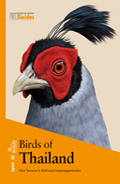
Birds
of Thailand This field guide has set new standards in identifying
birds in the wild in Thailand. With the most up-to-date
taxonomy of any publication this is the book you need
if you are birdwatching in Thailand. Forget all of the
older guides and buy this one.
Birdwatching
Trips:
Muang Boran Fishponds is a good place to include on a
tailor-made bird watching trip to Thailand as there are
a number of species which are easy to find there that
are not so frequently seen on most tours.
I
Hope You Enjoyed This Page
If you found the information you were looking
for here please let others know by liking this page on
Facebook and Tweeting it.



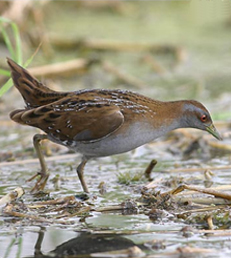 Baillon's
Crake
Baillon's
Crake








 Download
a full
Download
a full