Note1:
This article was originally published in Forktail 22 (2006)
the journal of the Oriental
Bird Club (OBC) and was kindly submitted by Philip
D. Round.
Note2: Since publication of this article many taxonomies
now split this taxon as Hume's White-eye with Everett's White-eye
restricted to The Philippines.
INTRODUCTION Two white-eyes caught and banded at Mo-singto,
Khao
Yai National Park (14°26'N, 101°22'E) on
14 July 2004 at 728 m were identified as Everett’s White-eye
Zosterops everetti. This provides the first confirmed
evidence of the presence of this species in north-east Thailand,
and is a significant extension of the species’s known
range, which was previously considered to extend from the Philippines
and the Greater Sundas, northwards through the Thai-Malaya Peninsula
and south-east Thailand to c.13°N (King et al. 1975, Lekagul
and Round 1991, Robson 2000).
The two birds were caught between 14h30 and 15h45 in a mist-net
placed at the side of a stream. They were ringed and colour-ringed,
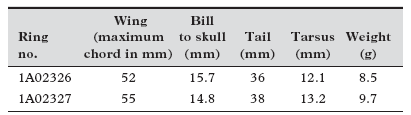
and their biometrics were recorded (Table 1). Both birds were
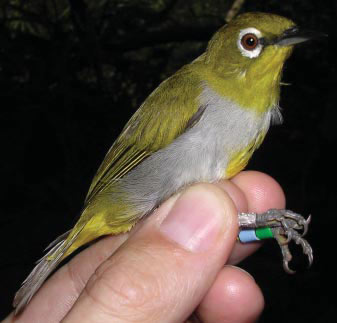
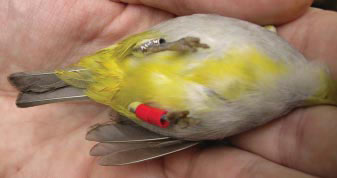
photographed using a digital camera (Plates 1–2). The
salient features of both individuals were the extent of the
yellow on the underparts, and the lack of yellow on the forecrown.
The entire upperparts from the crown to the uppertail-coverts
were uniformly cold olive-green. In particular, the crown, forehead
(extending to the base of the bill) and the earcoverts were
uniform olive-green. There was a sharp demarcation between the
olive-green ear-coverts and the yellow throat. The remiges and
rectrices were blackishcentred, with bright, narrow, yellow-green
fringes. A broad white spectacle was interrupted by a blackish
loral line. The undertail-coverts, hind flanks and thighs were
all yellow, and the yellow extended as an evenly broad, unbroken
median stripe onto the belly and lower breast. The upper breast
was whitish-grey, so that the yellow midline was cut off short
of the throat. The flanks were whitish grey. The iris was reddish-brown;
the legs were blue-grey and the soles of the feet fleshy-horn
(see Plates 1–2).
Table
1: Biometrics of two Everett’s White-eyes Zosterops
everetti ringed in Khao Yai National Park, Thailand, in
July 2004.
Plate
1 : Everett’s White-eye Zosterops
everetti, July 2004, Khao Yai National Park,
Thailand. Photograph: A. Pierce.
Plate 2 : Everett’s White-eye
Zosterops everetti, July 2004, Khao Yai National
Park, Thailand. Photograph: A. Pierce.
Although none of the standard field guides (e.g., King 1975,
Lekagul and Round 1991, Robson 1999) mentions the extent and
broadness of the yellow median stripe as a diagnostic feature,
this feature was shown by all Everett’s White-eye specimens
examined at the Natural History Museum, Tring, U.K. Specimens
of Oriental White-eyes Z. palpebrosus (other than
Z. p. melanurus and some Z. p. siamensis,
both of which may be completely yellow below) showed, at most,
a narrow broken yellow median stripe along the belly that
extended to neither the yellow on the vent nor the throat.
In many Oriental White-eye specimens there was barely any
yellow on the mid-line, and in all specimens the upperparts
were more yellowish-green, with extensive yellow on the forecrown.
Bearing in mind the difficulty of distinguishing the upperparts
colour (colder green in Everett’s, more yellowgreen
in Oriental White-eye) or the precise shade of greyish-white
on the flanks, the extent of yellow on the belly is possibly
the best field character for distinguishing these species.
So, how many species of white-eye are resident in Khao Yai
and the Dong Phaya Yen Forest Complex of northeast Thailand,
and do Oriental and Everett’s White-eyes occur there
together? In fact, Deignan (1963) did not list Oriental White-eye
for anywhere in the north-east, or away from the coast in
eastern Thailand. Although Dickinson (1963), Dickinson and
Tubb (1964) and McClure (1974) all listed Oriental White-eye
for Khao Yai, there were no Zosterops spp. among
the small number of bird specimens collected in Khao Yai during
the 1960s (Dickinson and Chaiyaphun 1968). The listing of
Oriental White-eye was based on conversation between E. C.
Dickinson and H. G. Deignan, in which the latter supposed
that Oriental White-eye was the most likely white-eye species
to be found in Khao Yai. However, in 1968, Dickinson identified
a flock of 12 white-eyes in Khao Yai as Everett’s White-eye
on the basis of their ‘very dark flanks’, and
all white-eyes he saw subsequently were likewise identified
as Everett’s White-eye (E. C. Dickinson in litt.
2005). White-eyes in Khao Yai were also independently identified
as Everett’s by S. Tantidapitak (verbally 2005), from
comparison of video images of both Oriental and Everett’s
White-eyes in other parts of their Thai range, especially
in the peninsula.
Thailand’s Dong Phaya Yen forest complex supports two
other species that, like Everett’s White-eye, are mainly
Sundaic in distribution: Scaly-crowned Babbler Malacopteron
cinereum and Moustached Hawk Cuckoo Hierococcyx vagans
(Lynam et al. in press, Lekagul and Round 1991).
These species, however, are known elsewhere in Indochina,
in south Laos (both), Cambodia and Annam (M. cinereum
only: Robson 2000). Although Everett’s White-eye has
now been confirmed in Khao Yai, there are, as yet, no records
from elsewhere in Indochina other than from Khao
Soi Dao, Chanthaburi province, south-east Thailand.
This strongly suggests that further surveys may reveal as
yet undiscovered, outlying populations of Everett’s
White-eyes in moist evergreen hill-slope habitats in Indochina,
almost certainly in the Cardamom Mountains of south-west Cambodia,
and perhaps elsewhere.
Thus, in addition to further surveys for Everett’s White-eye,
more work is also required to elucidate the range of Oriental
White-eye in north-east and eastern Thailand and possibly
elsewhere in the Indochinese region. Although Oriental White-eye
is apparently widespread in Indochina (King et al.
1975, Robson 1999, Dickinson 2003), in the absence of specimens
or photographs the presence of this species in Khao Yai and
elsewhere in Dong Phaya Yen must currently be considered as
unconfirmed. If it does occur, it is perhaps more likely to
be found at lower elevations, in disturbed habitats or deciduous
woodland around the park boundaries.
ACKNOWLEDGEMENTS
We are grateful to E. C. Dickinson and Sopitcha Tantitadapitak
for making details of their sight records available, and the
former for commenting on this paper. David Wells kindly commented
on white-eye identification. We thank the Department of National
Parks, Wildlife and Plants Conservation for permission to
work in Khao Yai, and the Natural History Museum, Tring, for
allowing access to specimens. Work at Khao Yai was supported
by grant BRT 346004 from the Biodiversity, Research and Training
Program, Thailand.
REFERENCES
Deignan, H. G. (1963) Checklist of the birds of Thailand.
U.S. Nat. Mus. Bulletin226.
Dickinson, E. C. (1963) A preliminary list of the birds of
Khao Yai National Park. Nat. Hist. Bull. Siam Soc.
20: 183–204.
Dickinson, E. C. (1967) A further contribution on the birds
of Khao Yai National Park. Nat. Hist. Bull. Siam Soc.
22: 173–184.
Dickinson, E. C. and Chaiyaphun, S. (1968) Notes on Thai birds
I. On a small collection of birds from in or near Nakhorn
Ratchasima province, Eastern Thailand. Nat. Hist. Bull.
Siam Soc. 22: 307–315.
Dickinson, E. C. and Tubb, J. A. (1964) Some additions and
corrections to the preliminary list of the birds of Khao Yai
National Park. Nat. Hist. Bull. Siam Soc. 20:
269–277.
Lynam, A. J., Round, P. D. and Brockelman, W. Y. (in press)
Status of birds and large mammals in Thailand’s
Dong Phayayen-Khao Yai forest complex. Bangkok: Biodiversity
Research and Training Programme.
McClure, H. E. (1974) Some bionomics of the birds of Khao
Yai National Park, Thailand. Nat. Hist. Bull Siam Soc.
25(3–4): 99–194.
Andrew J. Pierce, King Mongkut’s University of Technology
Thonburi, School of Bioresources and Technology, Bangkhunthien,
Bangkok 10150, Thailand. Email: andrew@pdti.kmutt.ac.th
Philip D. Round, Department of Biology, Faculty of Science,
Mahidol University, Rama 6 Road, Bangkok 10400, Thailand. Email:
frpdr@mahidol.ac.th
Central
Mongolia , 20th May-3rd June 2021 - Black-billed
Capercaillie, Oriental Plover, Henderson's Ground Jay, Azure
Tit, Pallas's Sandgrouse: Contact
me for details
Thailand
Raptor Migration, 26th Oct-5th Nov 2021 -
Black Baza, Grey-faced Buzzard, Pied Harrier, Lesser Fish
Eagle, Spoon-billed Sandpiper: Contact
me for details





 Central
Mongolia , 20th May-3rd June 2021 - Black-billed
Capercaillie, Oriental Plover, Henderson's Ground Jay, Azure
Tit, Pallas's Sandgrouse:
Central
Mongolia , 20th May-3rd June 2021 - Black-billed
Capercaillie, Oriental Plover, Henderson's Ground Jay, Azure
Tit, Pallas's Sandgrouse:  Thailand
Raptor Migration, 26th Oct-5th Nov 2021 -
Black Baza, Grey-faced Buzzard, Pied Harrier, Lesser Fish
Eagle, Spoon-billed Sandpiper:
Thailand
Raptor Migration, 26th Oct-5th Nov 2021 -
Black Baza, Grey-faced Buzzard, Pied Harrier, Lesser Fish
Eagle, Spoon-billed Sandpiper: 
 South
Korea, 5-17th January 2022 - Steller's Sea
Eagle, Relict Gull, Red-crowned Crane, White-naped Crane,
Baikal Teal, Solitary Snipe, Asian Rosy Finch:
South
Korea, 5-17th January 2022 - Steller's Sea
Eagle, Relict Gull, Red-crowned Crane, White-naped Crane,
Baikal Teal, Solitary Snipe, Asian Rosy Finch: