Having spent a couple of days doing "touristy"
things in Kanchanaburi I was itching to get out and see some
birds, something my girlfirend (she's my wife now), Srasri,
wasn't too enthusiastic about; so a visit to Hellfire
Pass offered me the chance to do some birding without
the visit appearing to be a birding trip: sneaky!
Arriving at about 7.30 am the car park was quiet with a number
of common, open-country birds in evidence; Spotted Dove, Common
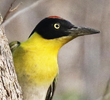
Iora, White-rumped Munia and Lineated Barbet were all easily
seen whilst attempting to locate the beginning of the trail.
I was keen to find the small trail which the interpretative
map indicates winds through limestone outcrops, with the possibility
of seeing Limestone Wren-babbler. After finding this trail
we had walked only a few metres along it when a noisy party
of Laughingthrushes drew my attention. Both Greater and Lesser
Necklaced Laughingthrushes were foraging in and around a large
tree which we were able to look down upon from atop a limestone
outcrop, giving us a great view. One or two Racket-tailed
Treepies also contributed to the chorus as did a Greater Racket-tailed
Drongo, mimicking the call of a Green Magpie.
Continuing along the trail the forest appeared promising,
however it revealed little other than a few Yellow-bellied
Warblers, common birds in this sort of habitat. Mosquitos
proved themselves to be abundant though and we were soon forced
to apply insect repellant which Srasri had thankfully packed.
This activity proved how beneficial periods of quiet standing
can be when searching for birds in forests as just as the
insect repellant had been packed away along came a noisy pair
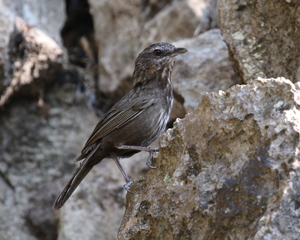
of Limestone Wren-babblers scolding each other amongst the
cracks and crevices of the rocky outcrops. So intent on bickering
were they that we went unnoticed and obtained fantastic close-up
views of this much sought-after species; these were birds
of the crispifrons subspecies, their dark plumage
and larger size leaving no room for confusion with Streaked
Wren-babbler.
The departure of these birds and the pestilential mosquitos
prompted us to move on and take a look at Konyu Cutting which
was nick-named Hellfire Pass by Allied prisoners of war. Seeing
this excavation through hard rock, which was largely dug by
hand was a sobering thought; add to this the boiling heat
and mosquitos in plague proportions, the thought of young
men working under brutal conditions here was quite upsetting.
From here the trail continues along the route of the railway
for four kilometres, offering the chance to explore the surrounding
countryside and no doubt see quite a number of birds, however,
the insect repellant was rapidly sweating off so after stopping
to watch Hill Blue Flycatcher, Puff-throated babbler and Forest
Wagtail we turned around for a look at the now-opened museum.
Some welcome refreshments were available in the museum, as
was the benefit of air-conditioning. Although small, the museum
is very interesting, with a short video showing the history
of the railway playing on a continuous loop.
An interesting and rewarding morning, both historically and
ornithologically, came to a nice end with a beautiful male
White-rumped Shama perched on a tree stump outside the museum.
Nick Upton
Birds seen at Hellfire Pass
Spotted Dove
Lineated Barbet
Forest Wagtail
Common Iora
Blue Winged Leafbird
Black Crested Bulbul
Greater Racket Tailed Drongo
Racket Tailed Treepie
Puff Throated Babbler
Limestone Wren Babbler
Greater Necklaced Laughingthrush
Lesser Necklaced Laughingthrush
Striped Tit Babbler
Yellow Bellied Warbler
Common Tailorbird
Hill Blue Flycatcher
White Rumped Shama
Black Naped Monarch
Common Myna
Ruby Cheeked Sunbird
White Rumped Munia






 Download
a full
Download
a full